
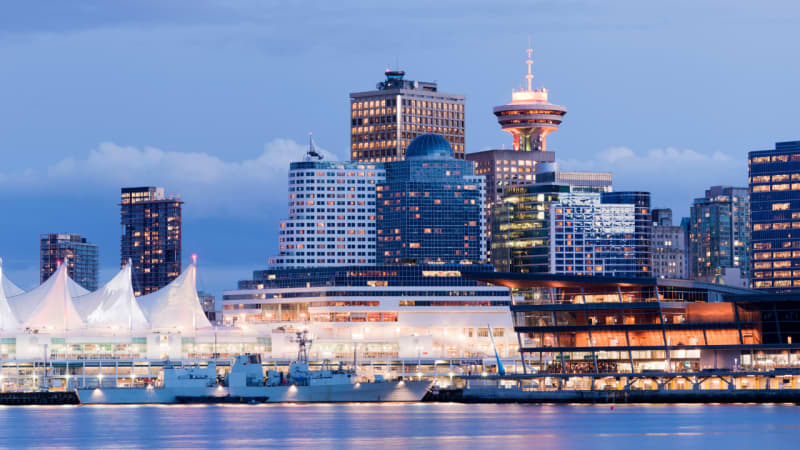
Vancouver by Campervan: What to See in the City Where Ocean Meets Mountains
Arriving in Vancouver after more than three years traveling in our campervan felt like opening a completely new chapter.
After crossing Europe, Asia, and living for a year in Japan, Canada welcomed us with a completely different feeling: huge spaces, wide roads, endless forests, and a city that seems almost unwilling to choose between urban life and nature.
Because that’s exactly what Vancouver is: a modern metropolis overlooking the Pacific Ocean, with snow-capped mountains in the background and an incredible number of parks and trails reachable without practically ever leaving the city.
It’s not a city to visit just by looking at monuments. Vancouver is meant to be lived by walking, cycling, stopping in front of a sunset, or simply observing the contrast between skyscrapers and nature.
Where Vancouver Is and Why It’s Special
Vancouver is located in the province of British Columbia, on the west coast of Canada.
It’s one of the country’s largest cities, with about 700,000 residents (over 2.6 million considering the entire metropolitan area).
Its location is probably its main strength:
- to the west, the Pacific Ocean
- to the north, the North Shore Mountains
- huge urban parks within the city
- forests and trails just minutes from downtown
It’s not unusual to see people leaving work and heading straight out for hiking, kayaking, or a walk in nature.
Stanley Park: Vancouver’s Green Lung
If there’s one place to start your visit, it’s definitely Stanley Park.
With over 400 hectares, it’s one of the largest urban parks in North America and occupies a peninsula completely surrounded by water.
The best part is the Seawall, a scenic path of about 10 km that circles the park, offering views of Vancouver’s skyline, beaches, giant cedar forests, and mountain viewpoints.
One of the park’s symbols is the Totem Poles, installed in the Brockton Point area, which tell the story of the indigenous cultures of the northwest coast.
Gastown: The Origin of Vancouver
Before the skyscrapers, there was Gastown. This is the city’s historic neighborhood, born in the late 1800s around the figure of “Gassy Jack,” a sailor and saloon owner considered one of Vancouver’s founders.
Today it’s a completely different area, with brick buildings, historic lampposts, independent shops, restaurants, and cafes.
The neighborhood’s symbol is the Steam Clock, built in 1977, which lets out its characteristic whistle every 15 minutes.
It’s definitely touristy, but a walk here is worth it.
Granville Island: Market, Craftspeople, and Local Atmosphere
Despite its name, Granville Island isn’t an island far from the city, but rather a peninsula easily reachable from downtown.
It’s one of our favorite spots because it has a much more relaxed atmosphere than downtown.
Besides wandering among houseboats floating on the water and containers repurposed as small workshops, stop by the covered market, which offers a wide selection of food for every taste.
Chinatown: History and Change
Vancouver’s Chinatown is one of the oldest in Canada.
Born in the late 1800s with the arrival of numerous Chinese immigrants, today it tells a story of traditions, hardships, and transformations.
It’s an interesting area because it also shows the more complex side of the city, where not everything is as perfect as on postcards.
How Much Time Do You Need to Visit Vancouver?
In our opinion:
- 2 days to see the main sights
- 3-4 days to experience the city at a relaxed pace, including nature and less touristy neighborhoods
If you have more time, we also recommend:
- Capilano Suspension Bridge (paid entry)
- Grouse Mountain
- Lynn Canyon
- Kitsilano beaches
Our Final Impression
Vancouver wasn’t just the first Canadian city we saw. It was our first taste of a different continent, a city where you can drink a coffee among skyscrapers and, just a few hours later, find yourself in front of an ancient forest.
Maybe that’s exactly its charm: you don’t have to choose between city and nature. Here, both coexist.
After the city, our route took us onto the water: also read our itinerary to Vancouver Island by campervan, between Victoria, ancient forests, and the Pacific Ocean.
The journey continues.
If you'd like to thank us, you can offer a 🍪 for our furry friends at the following link:
PayPal - Satispay

Scan the code and thank you! 🐱🙏



Denmark by Campervan: Our Itinerary

Rabat by Campervan: What to See in Morocco’s Capital

What to See in Osaka in One Day (plus a few extras not to miss)

From Italy to Japan by Van

100,000 km by campervan

From the Windmills of La Mancha to Toledo: A Spectacular Campervan Tour!

7-Day Itinerary Through Iraqi Kurdistan by Campervan: Celebrating Nawruz

Here’s How to Enter Japan with a Vehicle Without a Carnet de Passages

📝 Click to load Disqus comments
Comments will load dynamically