

Senegal by Campervan: Itinerary, Tips and Useful Information
Going to Senegal by campervan wasn’t part of our original plans, but, inspired by the stories of other camper travellers (which you can listen to here ) and after reaching Western Sahara, we found ourselves crossing Mauritania, the country that divides the Arab world from Black Africa.
After almost 30 days spent in Senegal, a few misadventures at customs and beyond, countless encounters with locals, words learned in the local dialect, practical solutions found here and there, and information useful to camper travellers and beyond, it occurred to us to write an article about our adventure, hoping it might be useful to anyone thinking about taking on a similar trip.
Table of contents
Itinerary
In this section we’ll list all the stages of our adventure, recreating a little day-by-day diary. If you want to read our itinerary in brief you’ll find it here, while if you want to read our thoughts on the country and above all the unmissable stops, you can do so by clicking here.
Entering the country, Saint Louis and Lake Retba
Day 1: we arrived at the Senegalese border crossing of Diama in the late morning, then headed straight to Saint Louis. Crossing the town, the impact is striking: a first central island decorated with colourful colonial houses gives way to a bridge leading to the fishermen’s island, plagued by rubbish on every corner, children wandering among a multitude of stray dogs and goats, a beautiful beach characterised more by waste than grains of sand. We parked the van south of the fishermen’s island, wild camping and completely undisturbed.
Day 2: we took the chance to visit the Saint Louis Photography Museum . The visit is spread across 7 separate units, and in our opinion the real draw is the locations themselves - old abandoned houses, filled with art and untamed nature. Ticket price 2000 F (3 euros) per person, visit time 1.5 hours. We wild camped on the fishermen’s island (you can use the city buses to get around, or walk there like we did).

Day 3: we used the time needed to sort out a couple of issues with the vehicle’s passavant (you’ll find everything about this in the dedicated chapter) to visit an organisation in Saint Louis that works to rescue talibé children from the streets (little ones sent by the poorest families to study the Quran with figures who should be responsible for their education, the Marabouts, but who instead profit from their wandering, making them live in dreadful conditions without toilets or enough food, beating them without giving them medical care in case of infection). At the Maison de la Gare we were welcomed by Issa, the director, with a mix of joy and emotion as he told us how hard it is every day to run an organisation that lives mainly on donations. In the afternoon we moved on to Zebrabar, the famous campsite overlooking the ocean.
Day 4: after the strong impact the country had on us, which made us wonder more than once why we’d decided to visit it, we took advantage of the peace offered by this spot, immersed among trees, with a clean strip of beach and little monkeys free to wander around in the morning. In the late afternoon we moved on and slept at a petrol station halfway along the route.
Day 5: we reached Lake Retba, better known as the Pink Lake, a UNESCO World Heritage Site, which has lost the distinctive pigmentation of its waters due to torrential rains that, at the end of 2022, washed away the piles of salt and meant the algae responsible for the pigment could no longer recreate the magic of the place. Even so, we were greeted by a blue lake, with foamy water at the shore, rubbish here and there and an air of desolation, tied to some crumbling structures. We wild camped on the lakeshore.

Dakar and the Petite Côte
Day 6: driving in the capital, Dakar, isn’t one of the easiest experiences, which is why, studying the map, we went around the city from the outside, taking advantage of an appointment in the outlying district of Guédiawaye. Here we visited a school that teaches girls to sew, helping to find them internships to get into work (for information, the Sunugal project and the Gis Gis association, whose products are sold in Italy at ecomercato outlets). In the early afternoon we continued along the “corniche ouest” road to visit the giant 49-metre bronze statue depicting a man, woman and child that towers over the city’s rooftops and the Atlantic (the African Renaissance Monument, which can also be visited inside for a fee). We parked in a quiet, shaded side street to head to Independence Square and get the first extension stamp on the vehicle’s passavant, granting the first 15 days of permission. We arrived 15 minutes before closing and the process was quick! We took advantage of being close to the port to visit a local market: expect to be invited to stop at every stall to buy something, and arm yourself with patience and firmness where needed! We parked on a tree-lined avenue in the embassy district, though you’ll also find a campsite in the city.
Day 7: we visited Gorée Island, better known as slave island, early in the morning for two reasons: to leave the animals on board the van without them suffering the heat, and to avoid the crush of tourists mixed with local vendors. We boarded at 7.30am along with about ten other passengers (the ferry normally leaves every half hour from 6.15am to 10.30pm, price 5200 F or 8 euros return per person) and after 20 minutes we were on the island. Around us only the sound of nature waking up, a few people busy making breakfast and hanging out washing, artworks scattered here and there to admire in silence. We walked the whole perimeter, reading about the history of the place and imagining the atrocities suffered by the men, women and children who were sorted here and stripped of their identity before being packed aboard the ships that would take them to the Americas to work and die on the plantations. On the island there are also a couple of museums (the one about the slave house has terrible recent reviews!) and some restaurants, as well as shops scattered here and there (if you want to know more, click here ). We returned to Dakar on the 10.30am ferry, which arrived on the island carrying around 300 people, tourists and locals combined. We struggled to reach the motorway because of city traffic, and arrived on the Petite Côte just in time for lunch. Our temporary stop to break up the journey was Yenne, facing the coast and dotted with abandoned resorts and a few buildings under construction. We wild camped with the van along the beach, in a quiet spot but overrun with mosquitoes! Campsites are available nearby.
Day 8: driving along the N1, in better condition than the roads in the north, we reached La Somone, a village overlooking the lagoon that you can explore aboard the famous pirogues. We took the chance to stroll through the village market, buy fruit and vegetables and walk along the beach. The contrast between the cleanliness near the resorts and the piles of rubbish on the back streets is really striking. Along this stretch of coast we saw many tourists surfing. We slept in the guarded car park near the beach.

Day 9: we reached the not-too-distant M’Bour to visit, in the morning, an Italian association that supports the area’s talibé children ( Maison des Enfants ). Together with other volunteers we made sandwiches for the kids and then played with them, keeping them entertained in simple ways, while the infirmary was in operation. Leaving the place with a bittersweet feeling, wondering whether our help had really made a difference, we dropped the idea of visiting the fish market because of the heat, which would have put a strain on our animals, and headed to Joal-Fadiouth. We slept on the rather dirty beach across from the island, but had a peaceful night.
Day 10: online you’ll find information saying the shell island can only be visited with a guide. When we arrived at the start of the bridge, though, we found no one to ask, so we walked around on our own, treading on the countless shells that cover the whole ground and reaching the cemetery that hosts both Muslims and Christians in the shade of a few baobabs. We didn’t linger too long in the area, since the whole landscape is dotted with rubbish that makes the walk not particularly pleasant. We then quickly reached the nearby village of Fadial, home to the Sacred Baobab, majestic and viewable from inside through a crack, though a sharp smell coming from it made us hold back from going in. If you want to see it in full bloom, you need to visit during the rainy season.

Heading to Casamance
From here on we could have chosen between two options: crossing Gambia and its border, or going around it, taking a longer route through the more inland areas of the country to reach Casamance (for all the alternatives, see the dedicated section). Since we’d already had problems entering the country, and having met several people who’d told us various anecdotes about corrupt checkpoints, we decided to cover more kilometres and head to the town of Tambacounda. The only problem we ran into with this decision was the heat, which sent the van’s step buzzer haywire, stopping us from continuing for a couple of hours. This mishap forced us to stop in the city for the night, with 37 degrees inside the van and deafening traffic noise. There was only one “hotel” charging 11000 F (16 euros) to park in a spot, so we decided to move a little further on to a petrol station (a nightmare of a night).
Day 11: after getting up at 6am and filling up with diesel (at a Shell station that, as it turned out, gave us diesel mixed with water!), we set off determined to reach Casamance by evening, so as not to waste any more precious time. The road turned out to be quite different along this stretch: very little traffic, tarmac in excellent condition (except for a few potholes near the end), very few speed bumps, lush nature, small villages with thatched-roof houses and smiling people. The impression was really excellent, so much so that this was the place where we started to actually enjoy our trip through Senegal. We had lunch in the shade of a tree under the curious gaze of women and children, whom we greeted joyfully, then set off again and reached a car park 10 minutes from Cap Skirring in the late afternoon, with no idea that this place would capture us for 6 days. We wild camped out in nature near an abandoned hotel (where we ended up staying for days).
Day 12: tired from the misadventures and the long stretch we’d covered, we decided to enjoy this little slice of paradise, walking on the white sand of a beach decidedly cleaner than those in the north, and greeting warmly everyone who passed by. For lunch we decided to try the country’s typical dish, thieboudienne, rice with fish and vegetables, offered here at 1000 F (1.50 euros a plate). In the afternoon we walked to nearby Kabrousse, the last town before the border with Guinea-Bissau, where a little village party was taking place. We were warmly welcomed, amid brightly coloured clothes and children running around and dancing.

Day 13: we took advantage of the slow pace of village life to buy the local bread, called tapalapa, at a cost of 200 F a piece, made from a mix of flours and baked in a mud oven. Don’t be fooled by its size, it’s noticeably smaller than a baguette but decidedly heavier! We also topped up our Orange SIM (you’ll find more information about this further up), had lunch at another small bar and wandered among cows, piglets and goats roaming free on the beach.
Day 14: in the morning we reached Cap Skirring, changed money at the only bank in town, bought watermelons in the airport car park, filled up on water at a small campsite (negotiating down to 1400 F, 2.15 euros, instead of the 4000 F asked for), while in the afternoon we walked along the beach to the border marked on the map with Guinea, crossing it as the crow flies.
Day 15: in love with the place and its people, we took our first swim of the year in the ocean, together with a young man named Ibu, learning words in the local dialect and finding out more about the local culture, while the countless mosquitoes and the 43 degrees inside the van, with no real shaded spots, started to make us think we needed to move on, partly to protect Olimpia and Sakè, our animals.
Day 16: in the morning we went to see the famous Fromager trees (very tall, thin-trunked but quite distinctive) of nearby Diembering, then we cooked the fish Ibu had caught for us aboard the van, and in the evening we took the chance to say goodbye for good to him and to our neighbours, a lovely French family we’d chatted pleasantly with every day.
Day 17: after saying goodbye also to Elizabeth, our favourite cook at Chez Marie, we headed first to Elikine, a small village from which you can see and reach Carabane Island (an excursion we recommend if you can spend the night there, taking advantage of the public pirogue’s timetable, which costs much less than the private one), then to Oussoye, famous for its sacred forest and the spread of animism, before reaching the Ziguinchor customs office to get the second 15-day renewal of the vehicle’s permit. From here, with 45 degrees inside the van, we set off towards Tambacounda, to go around Gambia again and admire the little villages that had charmed us on the way there. We didn’t manage to reach the city but stopped 2 hours short, sleeping in one of the pull-off spots along the road.
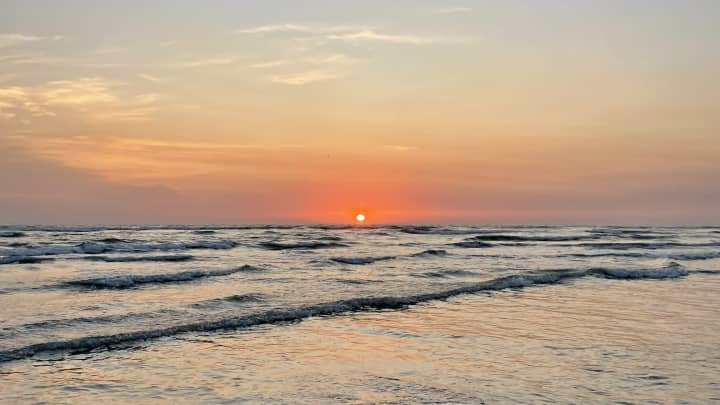
Day 18: having covered all the kilometres through the interior, we arrived in Palmarin, a small fishing village set in a natural area. Given the unbearable heat (over 40 degrees) we stopped at a campsite offering shaded pitches. Clean, with facilities and showers available, limited water fill-up, Wi-Fi useful only for the odd WhatsApp message, a pool and direct beach access (unfortunately the waters were swarming with jellyfish).
Day 19: we took advantage of the peace of the place to rest before the long trip back. Here too we found a small, family-run restaurant managed by a very kind woman, set near the ruins of a tourist village. This area is threatened by tides and rain, which are increasingly eroding the shoreline. We wild camped here, though we wouldn’t recommend it.
Day 20: we walked along the beach to the small village of Palmarin, meeting only a few men on horseback.
Day 21: last day in Palmarin, unfortunately while we were having lunch someone smashed the van’s rear window and stole our phone. After an afternoon spent at the gendarmerie we moved on to M’Bour (worth noting, the first Auchan supermarket in the area). We parked near the beach.
Day 22: we wanted to visit the fish market but lost the morning dealing with an attempted fine for dangerous driving (which we managed to get cancelled). We moved back to La Somone, where we slept in the guarded car park.
Day 23: from here on we preferred to retrace places we’d already been, just to be safe. So we moved to Yenne, where we’d slept on day 7. A terrible night, with an invasion of more than 50 mosquitoes!
Day 24: from Yenne we reached Zebrabar near Saint Louis (watch out for the last stretch of road, we got stuck in the sand!).
Day 25: we reached the Diama border crossing at 4.30pm, going through the exit paperwork quickly and without any problems. Keep enough Senegalese francs with you to pay the barriers and border fees, since they don’t accept euros (you can exchange leftover CFA at the Morocco border). We slept in Diawling National Park, giving ourselves a head start to cross Mauritania in a single day.

In Brief
Here’s the itinerary in brief. We always wild camped, except where otherwise stated
Day 1: Diama, Saint Louis - entering Senegal and visiting the fishermen’s island.
Day 2: Saint Louis - visiting the central island and the Saint Louis Photography Museum .
Day 3: Saint Louis, Zebrabar - visiting the Maison de la Gare organisation. In the afternoon, moving on and staying overnight at the famous Zebrabar campsite.
Day 4: Zebrabar.
Day 5: Pink Lake.
Day 6: Dakar - passavant renewal and visiting the city, in particular the Sandaga market.
Day 7: Gorée Island, Yenne - visiting the island in the morning and moving on to Yenne in the afternoon.
Day 8: La Somone - visiting the village overlooking the lagoon. Overnight stay in the guarded car park near the beach.
Day 9: M’Bour - visiting the Maison des Enfants association, then moving on to Joal-Fadiouth in the afternoon.
Day 10: Joal-Fadiouth, Fadial - visiting the famous shell island and the Sacred Baobab. Moving on to Tambacounda in the afternoon.
Day 11 - 15: Cap Skirring.
Day 16: Diembering - visiting the famous Fromager trees.
Day 17: Elikine, Ziguinchor and Tambacounda - visiting the village of Elikine and the little villages along the road. Passavant renewal in Ziguinchor. Heading to Tambacounda in the afternoon.
Day 18: Palmarin. Overnight stay at the campsite.
Day 19 - 20: Palmarin.
Day 21: M’Bour.
Day 22: La Somone. Overnight stay in the car park near the beach.
Day 23: Yenne.
Day 24: Overnight stay at Zebrabar campsite.
Day 25: Diama and leaving Senegal.
Excursions
For these places we can’t give you our own opinion since we didn’t visit them, for reasons related to the climate and budget choices. We did, however, try to gather as much information as possible to share with you.
Niokolo-Koba National Park: located near the border with Guinea-Bissau, 600 km from Dakar, this is a UNESCO World Heritage Site with very rich fauna and vegetation, home to over 80 species of mammals. The area is crossed by dozens of waterways, including the Gambia River and its dense network of tributaries. So far we’ve heard several accounts of very high fees to pay and few animals to be seen. Temperatures in the area can also be very high (travelling with our animals, we weren’t able to visit it).
Djoudj National Park: a UNESCO World Heritage Site since 1971, located on the banks of the Senegal River, a few kilometres from the town of Saint Louis. It offers a natural habitat and good refuge during migration for over 400 different bird species, being a particularly rich area in vegetation and waterways.
Bandia Nature Reserve: located not too far from the capital, this is mostly a large zoo hosting animals imported from South Africa, offering safaris that obviously can’t compare to those in Tanzania or South Africa. Here too, the rates aren’t the cheapest, especially according to other travellers, for what’s on offer. Perhaps, if you have kids and love zoos, it could be a nice excursion.
The Sine Saloum Delta: can be visited aboard the typical pirogues
The Lompoul desert: located in the north of the country, can be visited with 4x4 or camel excursions
Customs and Roads
Entering Senegal by car, motorbike or with your own campervan is doable, with the right precautions and a good dose of patience. If you want to know more, click here to go to the dedicated article.
How much we spent
We can give you a figure for the Senegal leg alone, but it needs to be seen within the context of the whole trip, since arriving overland means factoring in the cost of the ferry to get to Africa, the kilometres needed to cross Morocco from north to south, the entry visa for Mauritania (to be paid twice, of course, if you make the same trip on the way back too) and the 750 kilometres needed to cross it.
Also because we crossed several countries on the continent, we can’t give you a figure for health insurance for Senegal alone, a figure that in any case varies depending on the company chosen, the agreed risk level and the age of the insured (for 3 months, for two 33-year-old adults, covering Morocco, Mauritania, Senegal and Gambia, which we weren’t sure we’d cross, we spent a total of 528.78 euros with ViaggioSicuri).
Quando ci troviamo in un paese straniero, soprattutto dove non accettano l'euro, ci affidiamo a questa carta gratuita, che ti permette di pagare senza alcun tasso o addebito.
Our expenses amount to:
- Fuel: 257 euros (3400 kilometres covered - diesel price 1-1.16 euros/litre)
- Campsites and car parks: 44.96 euros
- Motorway: 4.30 euros
- Groceries: 125 euros
- Restaurants: 25.40 euros (8 meals out for two people)
- Miscellaneous (mosquito repellent, internet, warning triangle, museum, etc.): 45.75 euros
- Gorée Island ferry: 16 euros
- Vehicle insurance: 30 euros
- Passavant: 250 euros
Thoughts and unmissable stops
Our first approach to Senegal wasn’t the best: the problems we had at customs, the sheer amount of rubbish everywhere, the issues of corruption and how poverty is handled in the country really shook us. It was only when thinking about whether and when we’d come back to these areas by van that we decided to try to reach the south, Casamance, an area that decisively lifted our spirits, both for the places we visited and for how welcoming the people were. None of the magic that the 7 days spent in this part of Senegal gave us was tarnished, not even by the unpleasant events that happened on our way out of the country. So would we go back? Maybe one day, yes. Definitely not any time soon. Do we recommend visiting the country? Yes. If only to truly experience something different, to understand a different culture, to try to find a rhythm of life dictated by the sun rather than by the hands of a clock.
Don’t expect grand architecture, and above all, don’t stop at the idyllic beaches in front of the resorts: try to seek out contact with local people, which is the real wealth of this country.
Unmissable stops:
- Saint Louis, with a visit to the fishermen’s island and the photography museum
- Dakar - more than the city itself, we’d absolutely recommend visiting Gorée Island
- La Somone and the pirogue trip along the river delta
- Casamance (our favourite stop in the country)
Stops to consider:
- the parks mentioned above, depending on your time and budget
Stops to skip:
- Pink Lake, since it’s currently no longer pink
- Petite Côte, too touristy and with run-down hotels
Our Vlog
If you want to watch our vlogs or hear our thoughts, here are the videos:
- vlog
- our thoughts
Our maps
Below you can browse all the maps for our trip. If you want to know how to download them and use them offline, you'll find everything at the following link⚠️ we can't guarantee that the marked spots still exist! Please keep the area clean and follow the rules.Vandipety takes no responsibility for how the information provided here is used.
If you'd like to thank us, you can offer a 🍪 for our furry friends at the following link:
PayPal - Satispay

Scan the code and thank you! 🐱🙏







Here’s How to Enter Japan with a Vehicle Without a Carnet de Passages

Entering Japan with Your Dog or Cat: How to Avoid Quarantine

Porto in One Day: Complete Itinerary and What to See

Rabat by Campervan: What to See in Morocco’s Capital
Denmark by Campervan: Our Itinerary

What to See in Osaka in One Day (plus a few extras not to miss)

Madrid in 1 Day for Free

7-Day Itinerary Through Iraqi Kurdistan by Campervan: Celebrating Nawruz

📝 Click to load Disqus comments
Comments will load dynamically