read also
Amsterdam with Dog and Cat: 3 Unmissable Stops


We visited and lived in the Netherlands aboard our van, with our dog and cat as travel companions, in August 2022. We were captivated by the landscapes and the kindness of the people, as well as the beauty of several touristy and lesser-known sites. It’s definitely a trip we’d recommend to anyone, not just by van but also arriving by plane and making use of the excellent public transport network.
Table of contents
In this section we’ll list all the stops of our adventure, recreating a short daily diary, and pointing you to a dedicated section for our visit to the capital, Amsterdam. We arrived in the Netherlands from Northern Germany and crossed the whole country from north to south, then headed into Belgium.
If you want to jump straight to the conclusions and the map with all the stops and the places we think are most worth it, click here.
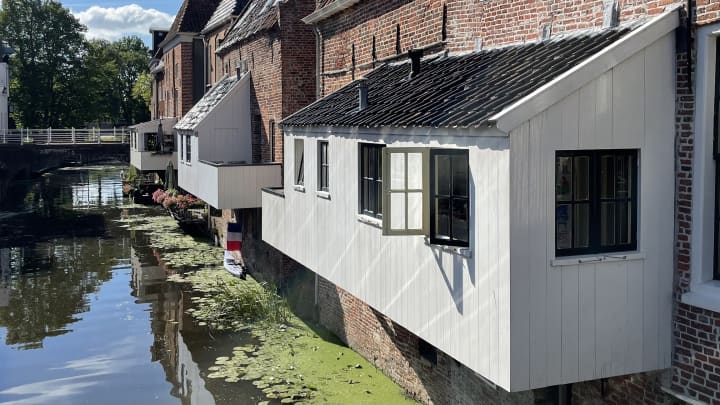
Day 1: the first Dutch village we visited was Bourtange. We parked at the information centre from which the walk to visit the old village begins, with walls surrounding small mills and houses turned into shops or hotels, immersed in a time that seems to have stopped (pets allowed). Having finished the visit, we headed to Appingedam, a village known for its houses with kitchens suspended over the canal. A single main street shows genuine little cubes poking out of the buildings, at various heights. Behind the curtainless windows you can imagine stepping into those kitchens and smelling coffee, cinnamon cake, fresh hydrangeas. Then we headed to the city of Groningen (we stayed overnight for free on the outskirts, along the shore of a lake).
Day 2: after strolling along the lake shore, we decided to visit the city market, reached on foot along the canal and discovering the first houseboats. We moved to park for free at Ikea. Arriving in the centre we took a look at the old Jewish quarter’s street, now lined with countless different shops, all the way to the old synagogue. In the market square there are numerous stalls selling local products, including cheeses and fish stalls also serving the famous herring-and-onion sandwiches (watch out for the seagulls, they’ll try to steal your food!). Back at the van, we decided to move to a spot right in nature, near Haulerwijk, to let Olimpia and Sakè roam free outdoors.
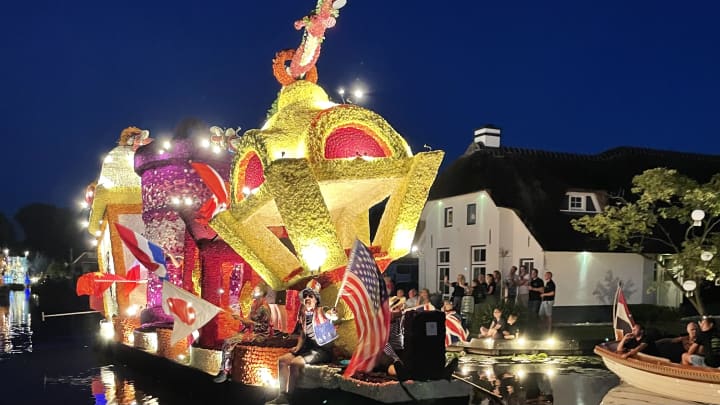
Day 3-4-5: after walking through open countryside and having lunch by a small canal nearby, we reached the neighbouring village of Giethoorn, famous as the little Dutch Venice. We found a lovely spot, but in our opinion a bit spoiled and made too commercial, with huge numbers of tourists, almost all aboard gondolas and small boats. The village is a maze of canals, well-kept cottages, tended gardens, plenty of Airbnbs, small shops. We preferred to wander aimlessly, going back and forth from one side to the other. For the night we moved to a car park 10 minutes away, at the small village of Belt Schutsloot: a maze of canals lit by little lampposts and lanterns, colourful hydrangeas, houses with no fences and an atmosphere of pure magic. We stayed in that setting for 3 days, making friends with the locals and helping build the flower-covered gondolas that would parade along the canal for the famous festival (if you want to know more about this 70-year-old tradition, you’ll find it all in this video, while you’ll find the upcoming technical details at this link ).
Day 6: one last wake-up overlooking the canal, then we moved half an hour away to make use of a service station at a harbour, then to the village of Urk and finally to a car park overlooking the shore, found by chance, at Oostvaardersplassen.
Day 7: the road we drove in the afternoon was completely immersed among fields and stretches of wind turbines, all the way to a village suspended between bridges and canals, Onderdijk. Time here seemed to have stopped: we took a stroll among the canals and courtyards of the houses in what seemed to be a ghost town, with cobwebs on cars and plants and quite a bit of litter around, which left us a bit dismayed. Back at the van, with a humidity level that lowered our tolerance considerably, and since the smell of frying from a street vendor was seeping into our home’s walls, we decided to move to another car park, reaching a nearby village that was decidedly more inviting, Medemblik.
Day 8: with the weather still unstable, we visited the village in the afternoon. The houses are arranged in tidy rows along a chessboard of little streets and canals. After chatting a bit with the locals, we kept walking aimlessly among the canals. Just before heading back to the van we bought some vegetables from a small box in front of a two-storey building’s door, leaving the money in the letterbox (a typical custom here as in other Northern European countries). For the night we moved to Hoorn.
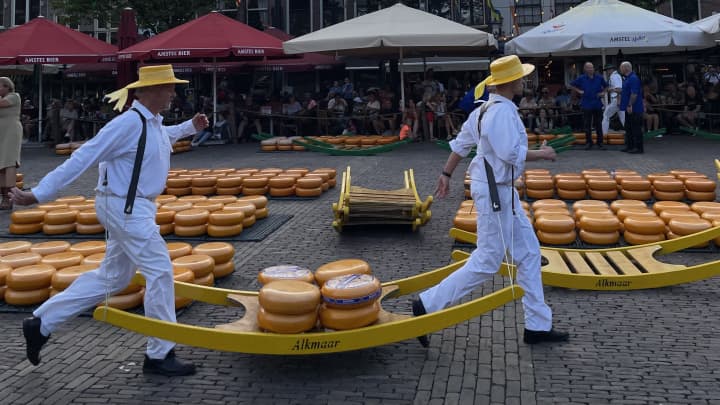
Day 9: Hoorn was once an important trading port and in some way still holds a bit of that atmosphere’s charm. The historic centre is marked by characteristic buildings, which also feature the city’s symbol, the unicorn. In the days before our arrival a festival had taken place, which didn’t make our visit entirely pleasant, with litter everywhere and street cleaners at work. So we decided to head back to the campervan and reach the bank of a canal, right next to a windmill: an ideal spot for a walk, surrounded by fields and grazing sheep. From there we moved to Alkmaar. The city is famous for cheese production and its typical market, held every Friday morning and every Tuesday evening from 7pm to 9pm in the main square (you’ll find more information here ). Since it was Tuesday, we decided to make the most of it and dive even deeper into the atmosphere of local customs. After parking near a sports centre, we walked to the centre, all the way to the main square, full of round, orange-shaped towers of cheese, loaded onto carts and carried by pairs of men to the spots from which they’re then sold to the public. Curious, right? If you’d like, you can discover it all in our video . Alongside us were plenty of people, all watching that pattern of movement closely and sniffing the smell in the air. We got tempted by a cart selling sandwiches with slices of melted cheese, then went back shortly after to buy a third one. After buying a couple of pieces of cheese too, we headed back with our loot, more than satisfied.
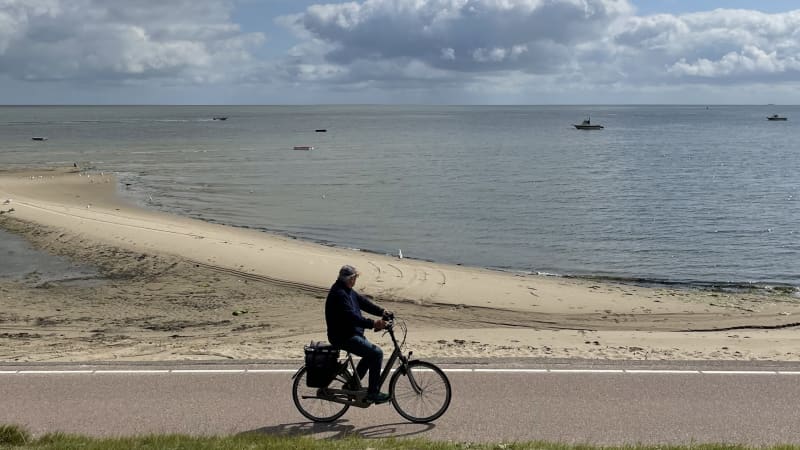
Day 10: under torrential rain we reached the train station to pick up Davide, a dear friend, with whom we’d visit the island of Texel. Together with him we arrived at a campsite near Den Helder, where a lovely elderly lady welcomed us. After having lunch and pitching the tent next to the van, we walked to the nearby dunes overlooking the North Sea. For a moment it felt like walking through the inland landscapes of Ireland. A single road, with gentle bends, flanked only by nature.
Day 11: we headed to the island of Texel, arriving at the harbour with perfect timing. The crossing takes about twenty minutes (you’ll find useful info here ). Once on land, we went straight to the lighthouse at the north of the island, parking at a spot with a sea view. The heat didn’t seem to want to give us a break, so we decided to head west, to a village on the coast. Having found a perfect car park to leave Olimpia and Sakè aboard, in the shade of some trees, we put on our swimsuits and headed to the beach, stopping only to try the typical Texel beer, before diving into the icy waters of the North Sea (want to feel the thrill with us? Take the plunge too!). In the late afternoon we came back by ferry and reached the campsite.
Day 12: we went back to Alkmaar, trying kibbeling for lunch, small pieces of battered, fried cod. Then we moved to Volendam, a small harbour village with few passers-by, a few bikes, tidy, well-kept houses overlooking the canal. Our last stop with Davide was the nearby island of Marken, reachable by ferry or by car crossing a strip of land. The centre is pedestrian and reserved for residents, and time here seems to have stopped 50 years ago. Past a small harbour, we walked on the cobblestones admiring the surrounding nature. In the late afternoon we reached Amsterdam, parking for the night at NDSM Wharf, an evolving hipster district, decorated with murals and with a good choice of evening venues.
Want to find out what we visited in Amsterdam over 2 days?: Want to find out what we visited in Amsterdam over 2 days? Click here.
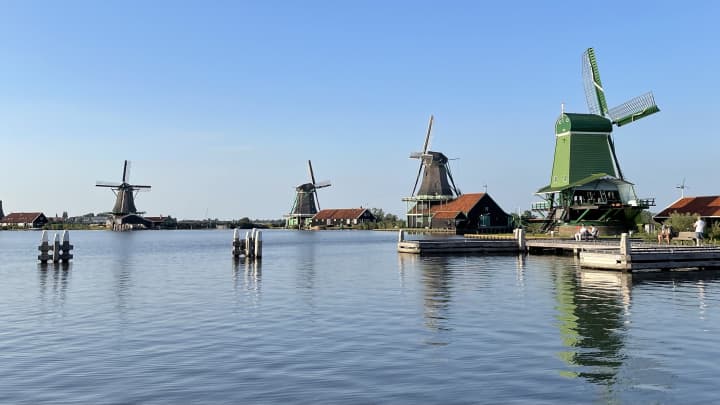
Day 15: having left Amsterdam, our first stop was Zaandam, which caught our attention with a hotel of unique shapes: cubes of various colours stacked one on top of the other from base to roof, almost forming a giant Lego structure. In the afternoon we reached Zaanse Schans, a village famous for its windmills. The pedestrian path, flanked by the cycle path, runs alongside about ten windmills, each used for different production. Then you reach a farm that produces cheese, passing by a couple of small shops and small houses, each more beautiful and well-kept than the last: flowers everywhere, a few free-roaming chickens, some sheep, ducks. We stayed overnight for free in the countryside.
Day 16: we stayed at Zaanse Schans to visit the inside of the farm selling the typical cheeses (prices a bit higher than at Alkmaar’s market) and a few of the shops that had already been closed the day before. An all-white little house sold chocolate. Every type and shape, especially windmills and tulips. From a doorway came a smell of butter; it felt like stepping into a giant filled dough: in the entrance hall they sold sweets of every kind, in packaging designed to attract kids, while at the back was the counter with freshly baked goods. Coming out of the sugary bubble, we were welcomed by a shop with the classic blue-painted ceramics. In the late afternoon we decided to head towards the town of Haarlem. After visiting the centre, reaching the main square canal by canal, we moved to the countryside for the night, at Spaarndam.
Day 17: we stayed in the countryside, walking along a cycle path and discovering the ruins of an entire wall that once bounded the possessions of the city of Amsterdam, before heading towards the coast. This area is home to nature parks, with limited access for animals. We weren’t able to fully understand the information about the day ticket, so we’ll leave you the link to the website. We walked to the beach crossing meadows and dunes, spotting deer in the distance, and went to sleep in a village not too far away, Katwijk, with a small harbour used as a car park.
Day 18: in the late afternoon we moved to Leiden. The town centre caught our attention right away. Tidy houses along the canals, façades painted in pastel colours, people sitting in the street with a peaceful, relaxed air. Some buildings leave you in awe for their well-kept details and the poems written on the walls in several foreign languages, and the sunset over the canals offers wonderful views. Well worth a visit. For the night we moved to a nearby car park, overlooking a lake.
Day 19: we moved to The Hague, or rather Den Haag, a city where it’s impossible not to glance at the numerous art galleries and vintage shops. For the night we moved to Delft, a very lively town, famous for its blue ceramics, which welcomed us with two live music shows in the town squares: swing in one square, rock in the other. We stayed overnight for free on the canal.
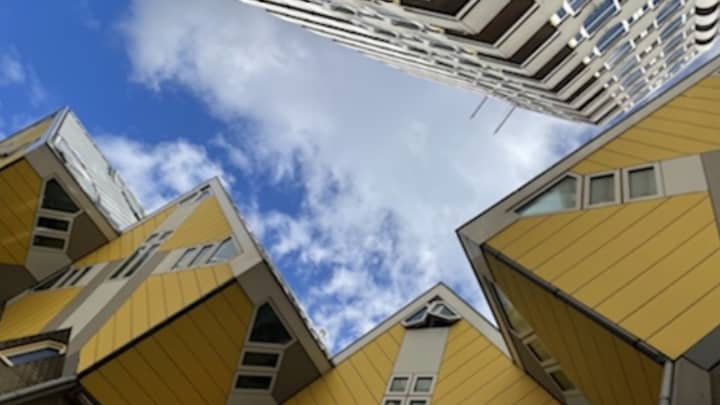
Day 20: since it was Saturday, we made the most of the weekly market, where everything is paid by card, even for just a few euros. We went for a small loaf that everyone nibbles on through the streets of the town, a mix of flour and cheese that melts at the first bite, then for lunch we tried kibbeling again, eating standing up leaning against a small table and listening to the music from the cart performing a little further on, echoing across the whole square. Leaving Delft, we moved to Rotterdam. The surrounding landscape became more industrial, while in the background the first of many skyscrapers and tower blocks we were no longer used to started appearing. The city’s architecture is decidedly different from all the Dutch villages. We parked in the centre, paying (check the parking meters, since at certain times it’s free), visited the central market (architecturally very beautiful from the outside) and headed to the nearby cube houses: built in the 1980s, they’re now 38 private homes, plus a museum. They’re also called the neighbourhood’s forest, since in the project’s vision they were meant to recall tree canopies. The visual impact is remarkable, and from whichever angle you look at them, you’ll want to stop and stay a bit longer. From here we reached the harbour to admire the skyscrapers towering over the canal. Back at the van, we moved to the city’s oldest district, spared by the bombing, with building façades similar to those of the other villages.
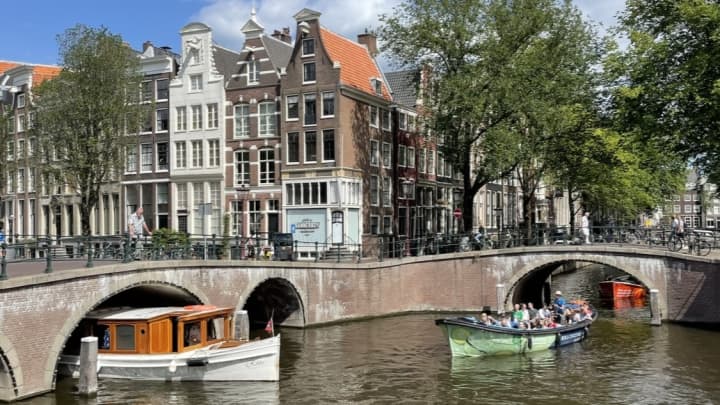
Day 21: a stop in Dordrecht, then on to the town of Gouda, famous for cheese production. We stayed at the square with free facilities for campervans, then explored cobbled streets, bridges suspended over the canal, the square with the wonderful town hall. In the evening we arrived in Utrecht, where we stayed a week to spend time with our friend Davide. We rented bikes (careful, you brake with the pedals!) to easily reach the centre, having left the van a bit outside the city, but you can also make use of the handy bus lines (tickets are bought on board and can be paid by card). The city centre entirely overlooks the canal, lined with houses and venues full of detail. If you get the chance, look for a brewery with wooden tables and chairs where you can freely play pool or board games, and order a beer along with the typical meatballs called bitterballen! There are some really lovely parks in the city; it’s worth taking a slow walk and sitting on a bench to watch the sun go down behind the rooftops, just like the Dutch do. Leaving Utrecht, we headed back towards Gouda, in the direction of Belgium.
Below are just the stops. We always stayed overnight for free, except where noted.
Day 1: Bourtange - Appingedam - Groningen
Day 2: Groningen
Day 3-4-5: Giethoorn - Belt Schutsloot
Day 6: Urk - Oostvaardersplassen
Day 7: Oostvaardersplassen - Medemblik
Day 8: Medemblik - Hoorn
Day 9: Hoorn - Alkmaar
Day 10: Alkmaar - Den Helder, at a campsite
Day 11: Texel Island - Den Helder, at a campsite
Day 12: Alkmaar - Volendam - Marken - Amsterdam
Day 13-14: Amsterdam
Day 15: Amsterdam - Zaandam - Zaanse Schans
Day 16: Zaanse Schans - Spaarndam
Day 17: Spaarndam - National Park - Katwijk
Day 18: Katwijk - Leiden
Day 19: Leiden - The Hague (Den Haag) - Delft
Day 20: Delft - Rotterdam
Day 21: Dordrecht - Gouda - Utrecht
Day 22-: Utrecht
In the Netherlands the weather is often rainy, with winters that can be very harsh.
Spring can be the ideal season to admire the many blooming tulip fields, but you might still find cold, windy and rainy days.
Summer 2022 was decidedly good, with very warm and sunny days. Since the country is up north, remember the sun sets later than in Italy, so expect days that feel longer.
Road conditions in the Netherlands are excellent. Motorways are toll-free and no vignette is required.
Free overnight stays aren’t allowed anywhere in the country. There are numerous natural spots where we slept safely. There are plenty of campsites, not cheap, which don’t always allow using just the campervan service point. Finding these facilities isn’t always easy — they can sometimes be found in designated urban areas or near shopping centres or service stations. Near the island of Texel we weren’t able to stay overnight for free, and preferred to sleep at a cheaper campsite on the mainland, making use of the handy ferry.
Public transport is genuinely efficient across the whole country. Buses, trains, trams, ferries, bikes: we never had any trouble with either payments or schedules.
We didn’t know the Netherlands, and we have to be honest, certain features of it pleasantly surprised us. Even though the weather isn’t the most favourable, you can feel a calm and peaceful atmosphere.
By campervan or car, in our opinion the unmissable destinations are:
In the video below you can play tourist with us a bit, or find the full series about the country at this link .








📝 Click to load Disqus comments
Comments will load dynamically