read also
Morocco by Campervan: The Complete Guide


In this article we’re going to explore mountains, deserts and unexpected places in Morocco together. We got here after visiting the Atlantic coast and after coming back from our adventures in Mauritania and Senegal.
Our choices for this itinerary were always shaped by the tips in the fantastic guide written by our friends Rose and Fabio, I giramondo ma non troppo .
We let ourselves be enchanted and amazed, discovered unexpected allergies and tasted unusual foods, were welcomed like family, and ended up with shoes full of desert sand all the way up to high-altitude mountains. In short, it was a big adventure!
Table of contents
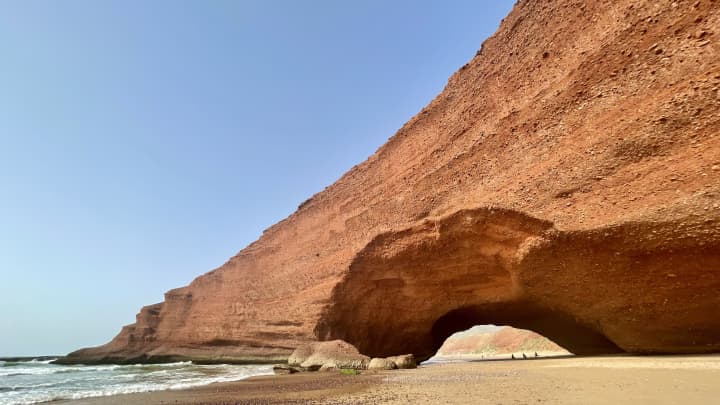
Having come back from what’s called “Black Africa,” we found ourselves right in the middle of “Ramadan,” which means facilities and services closed during the day and open in the evening almost everywhere. On top of that, for those who practise the Muslim faith, it means adapting to a different eating rhythm, and that’s how we found ourselves having dinner at breakfast time at friends’ houses (find out here what a feast!), tasting traditional sweets (guide in Italian), before crossing the country towards the desert on the Algerian border (which we tell you about in the third part of this trip), even managing to admire the Legzira cliffs, this time spared the sandstorm.
In this section we’ll list all the stops of our adventure, leaving Dakhla, Tan Tan and Tiznit behind us (which we visited in the previous article) and reaching Marrakech and the “Moroccan Switzerland” (you read that right, we haven’t gone mad!).
At the end of this article you’ll find our itinerary in brief, the map with all the pins for our stops (almost all wild camping), and our final thoughts.
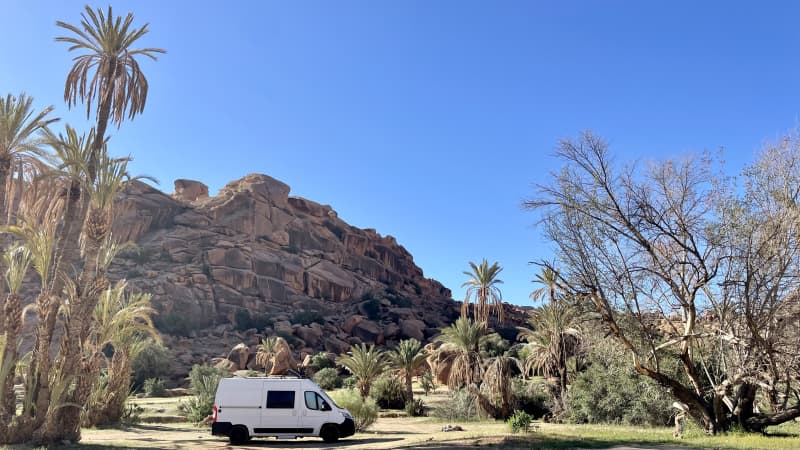
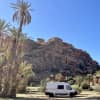
Day 1: we arrived in Tafraout, after crossing hills, scenic roads and enchanting landscapes. We headed straight to the palm grove to find a shady spot to rest, from which we reached the town centre on foot, under nothing but starlight, in a surreal atmosphere. Tafraout is famous for its production of colourful babouches, really unusual to look at and, why not, to wear. Parking costs 15dh per day but it’s supervised, with guards doing the rounds all night with torches to watch the area.
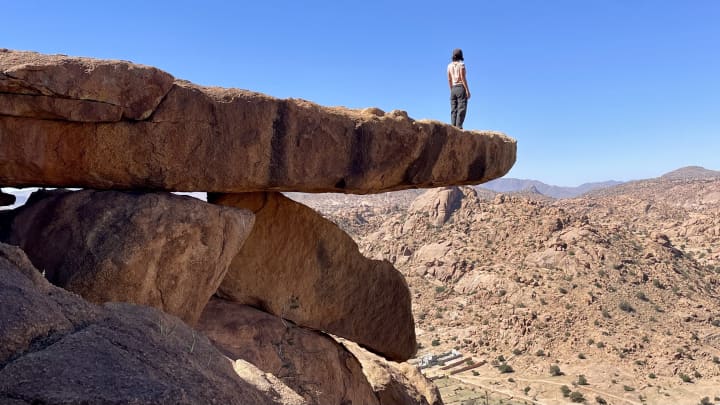
Day 2: we decided to treat ourselves to a genuinely thrilling adventure (which you can watch again in this video ) and reach, rock after rock, the famous “Tafraout diving board,” a rocky outcrop from which to admire a 360° view from above. We highly recommend this experience, which for us was one of the most thrilling in Morocco (all you need is a pair of hiking boots and a bit of a taste for adventure, plus some help from home with the coordinates never hurts).
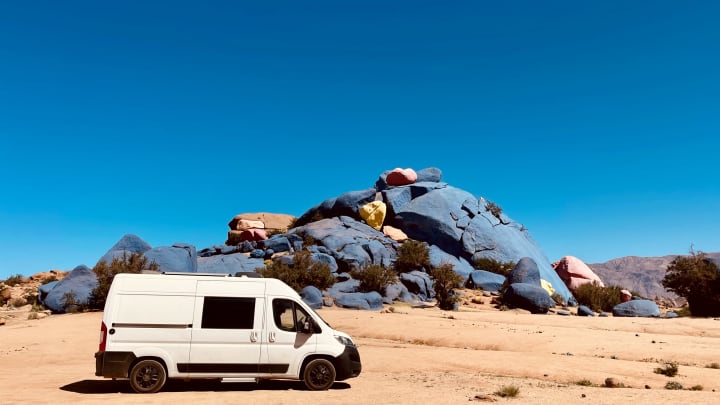
Day 3: we reluctantly left the palm grove to reach, together with our pets, the famous painted rocks site: it’s said that a Belgian artist painted them over time, giving the area a bit of colour. Some people love them, some criticise them; in our opinion they’re unusual enough to be worth a look. The road is unpaved but drivable.
Having also said goodbye to Tafraout, we headed along a truly scenic ridge road, so spectacular that it barely felt like we were still in Morocco. After a roadside snack of Moroccan bread and amlou (the typical almond-based dried-fruit spread found in this area, which we recommend trying), we arrived in Tata, in an area that looked like it belonged on Mars.
Day 4: Tata offers plenty of hiking options, especially among the palm groves. Unfortunately Sara discovered she’s allergic to palm-flower pollen, which is why, after a home visit from a doctor at the Tata campsite (by the way, we use this health insurance abroad and are really happy with it), we bought a stone-baked bread (we only found it here — if you see someone cooking it, we recommend trying it!) and moved away from the palm-grove area, admiring from a distance the one in the Tissint riverbed.
Day 5: if along the Atlantic coast we recommended upholsterers and campervan technicians in Tiznit, in Zagora you can instead find highly specialised mechanics and bodywork shops. It’s actually in this town that we had some van parts sealed with silicone after they’d suffered on the roads of Mauritania and Senegal.
Day 6: on the road that led us towards the desert, we made a few detours, including one to Serdrar. In this area you can walk on the dunes and go looking for fossils. Lots of people like to take these keepsakes home with them; we preferred to leave them where they belong.
Day 7-9: our second detour before reaching Merzouga, the most famous destination in the Sahara, was to Tarfaout Sidi Ali. We were supposed to go to a campsite recommended by friends, but when we got there and met Mustapha and his family, who run the Kasbha Maggaman property, we decided to stay with them for several more days. If you decide to venture to this magical place, where you can either park your campervan or stay in the property’s rooms, don’t miss a walk through the palm groves planted by Mustapha’s grandfather, who’ll be delighted to show you around his land. One last tip: taste the food prepared by the women of the house and let yourself be won over by their generosity. For us, these were wonderful days spent with what we consider a piece of family .
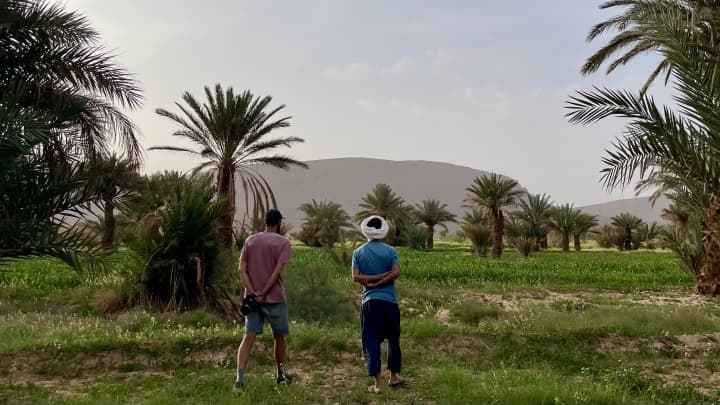
Day 10-11: after days full of emotions, we went to Rissani for a look around the famous Tuesday market, where you can find just about anything, before heading to Merzouga to treat ourselves to a spectacular sunset over the dunes. Here you can either venture out on foot or rely on one of the agencies renting quads or organising camel tours: this place is now super touristy, with lots of campsites offering a pool to cool off from the high temperatures.
Day 12-13: having left the desert because of the slightly uncomfortable temperatures and the problem of not being able to find shade under the palms due to Sara’s allergy, we headed towards the “Todra Gorge.” The most famous scenic stretch is the few kilometres that run right through a gorge carved between the rocks, along which there are numerous street vendors. Further on, the road remains very charming, but we didn’t want to venture too far north to avoid risking stretches that would require a 4x4.
Day 14-15: having crossed the valley of roses, though without seeing any in bloom, we arrived at the “Dades Valley.” Here too there’s only one scenic stretch, limited to the last high-altitude bends, which still create a spectacular switchback route. At the top there’s a restaurant/café, but we preferred to try Berber cuisine cooked by an entire family, savouring the flavours of tradition.
If you want to discover these spectacular roads and what we ate, you’ll find it all in this video.
Day 16: our next destination was Ouarzazate, where we decided to visit the famous Kasbah for 40dh per person (4 euros), without a guide.
Day 17: another very distinctive destination along this road known as “the road of a thousand Kasbahs” is Ait-Ben-Haddou. Nearby you can also visit the studios where many famous films were shot. We preferred a morning visit to the old part of the village before getting back on the road, arriving at Telouet, amid breathtaking mountain scenery. Continuing north along the P1506, you reach, through spectacular landscapes, the Tizi n’Tichka Pass at 2205 m of altitude. From here we carried on towards Marrakech.
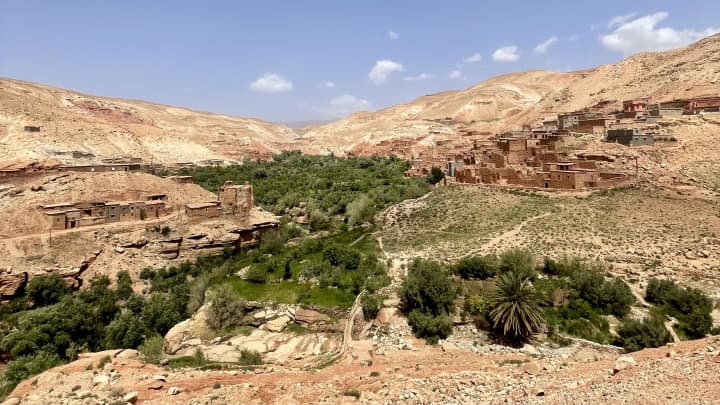
Day 18: of everything we got to admire in Morocco, Marrakech was one of the destinations we liked the least. It felt like a confusing market to us, where walking through the stalls means breathing in the exhaust fumes of mopeds zipping past in every direction and being constantly bothered. Even the famous main square left us feeling a bit down, home to drugged snakes and monkeys kept on leashes. Among the various tourist attractions, we decided to visit the Ben Youssef Madrasa , an ancient Quranic school, really well preserved.
After seeing and experiencing Morocco for almost two months, Marrakech felt to us like a huge tourist trap.
Day 19-20: leaving the big city and its chaos behind, we chose to explore the mountains around Marrakech and immerse ourselves in nature. Our first stop was Setti Fatma, where you can take lovely hikes to discover the waterfalls. You can venture out on your own, as we did, or with a guide.
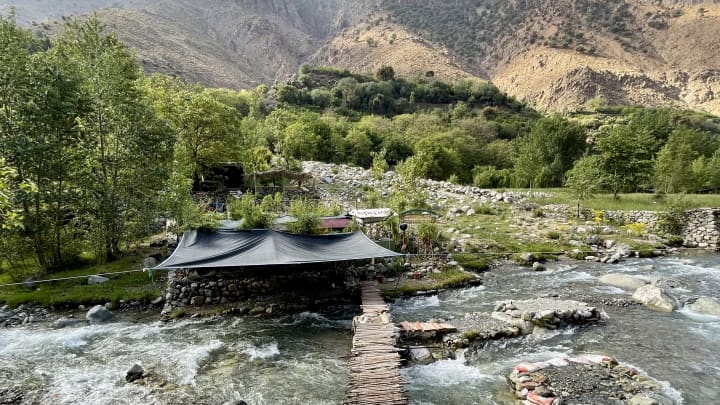
Day 21-22: another natural destination we really enjoyed was Imlil. Here too you can set off on foot in search of a lovely waterfall, found after crossing the small village, which is full of vendors selling all sorts of things.
Day 23-24: after admiring the “natural bridge,” a bridge naturally carved into the rock, we headed to the Ouzoud Waterfalls. We chose to visit them both in the evening and in the morning, venturing on our own along the path that runs alongside them. This magical place is now a well-known tourist destination, which is why we recommend an early-morning visit, to avoid too big a crowd and enjoy a moment of peace facing the roar of the waterfall.
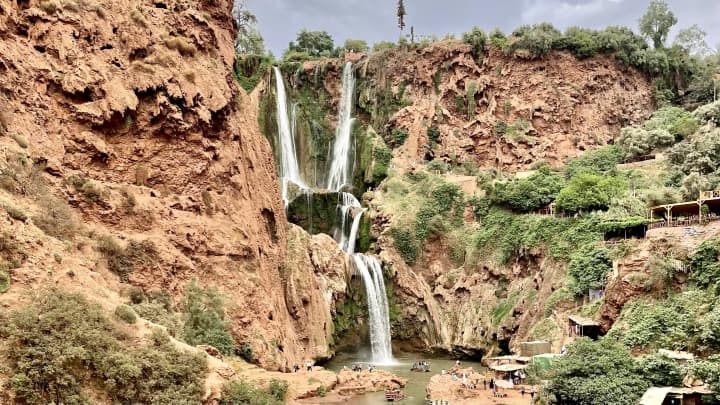
Day 25-26: when we arrived at Bin El Ouidane Lake, we decided to stay two days in this surreal place, hit hard by drought. Besides us there were only a couple of fishermen, in an all-round natural setting.
Day 27-29: on friends’ advice, we decided to head back towards the mountains once more, and after stocking up on fruit, vegetables and other food, reached the distinctive mountain known as the “Amsfrane Cathedral.” Here too we stayed a couple of days, admiring the untouched nature. On the way back, before reaching Bin El Ouidane Lake, we tasted a delicious pizza.
Did everything go well in these places? Find out in the video ⤵️
Day 30-31: still on the theme of nature, which is what we loved most about Morocco, we reached Lake Ouiouane, along whose shores you can walk while admiring the wild monkeys in their habitat.
Day 32: along the road leading to Ifrane, considered the “Moroccan Switzerland” for its half-timbered houses (by the way, it snows here in winter, did you know that?), we wanted to visit the Azrou cedar forest, home to numerous Barbary macaques. Unfortunately, given the high temperatures at the time (mid-May), the area was infested with processionary caterpillars, an insect dangerous for our pets, which we would have had to keep shut inside the van.
From this point on, our adventures in Morocco continued towards Fes, the Volubilis archaeological site, the Mediterranean coast and the Blue City, all the way back to Tanger Med. If you want to find out what we visited in these areas, you’ll find it all in this article.
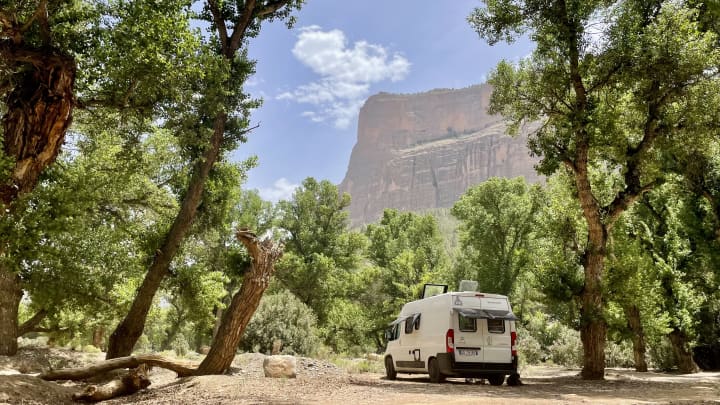
Day 1: Tafraout
Day 2: Tafraout (diving board rock)
Day 3: Tafraout (painted rocks)
Day 4: Tata
Day 5: Zagora
Day 6: Serdrar
Day 7-9: Tafraout Sidi Ali
Day 10-11: Merzouga
Day 12-13: Todra Gorge
Day 14-15: Dades Valley
Day 16: Ouarzazate
Day 17: Ait-Ben-Haddou, Telouet, Tizi n’Tichka Pass
Day 18: Marrakech
Day 19-20: Setti Fatma
Day 21-22: Imlil
Day 23-24: Ouzoud Waterfalls
Day 25-26: Bin El Ouidane Lake
Day 27-29: Amsfrane Cathedral
Day 30-31: Lake Ouiouane
Day 32: Ifrane
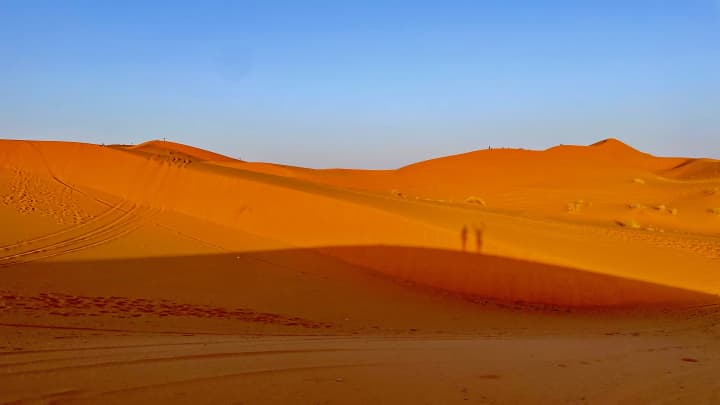
In this whole area of Morocco, two things stood out to us the most: the people and their hospitality (except for those only interested in getting money out of us, like the fake parking guards) and the natural landscapes. It was thrilling to discover mountains so different from the Piedmont Alps our eyes had grown used to over thirty years, to taste dishes cooked at home for Ramadan, and to experience a traditional Morocco beyond just the touristy one.
It’s really hard to rank all these destinations, which is why we’ll just say that what we liked least was visiting the big, chaotic city of Marrakech.
It was lovely to live alongside people who’ve called this land home for decades upon decades, learning about its past and the risks its future faces because of drought.
Looking back, these places and the emotions we experienced here are probably what we’ll remember most from our whole stay in Morocco.
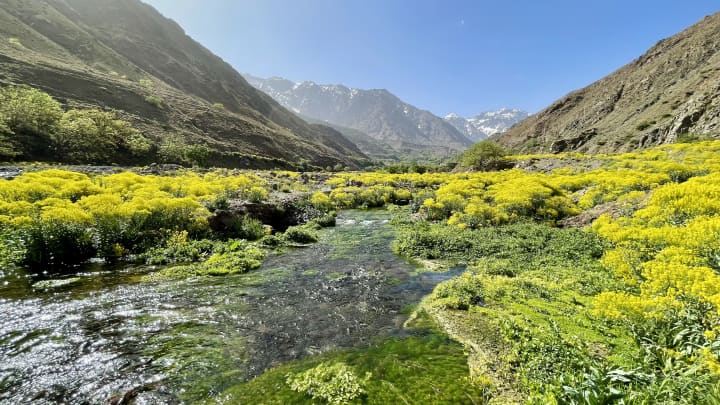
Click here to see all our adventures in Morocco:






📝 Click to load Disqus comments
Comments will load dynamically