
read also
Senegal by Campervan: Itinerary, Tips and Useful Information
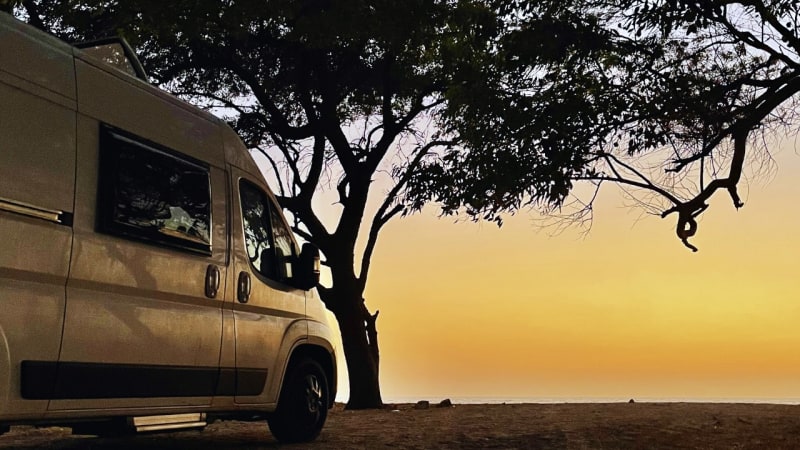

Is it possible to enter Mauritania aboard a campervan? In this article, we’ll share useful information on how to enter Mauritania by campervan, including the documents you’ll need and the passavant. Certainly, if you read the Farnesina ’s travel advisories, it’s not one of the most recommended places to visit.
Precisely for this reason, and given that we only crossed the country on our way to Senegal (which you can find here), we can’t write a detailed guide to the place. We’ll still share all the information related to customs procedures, costs and road conditions. We’ve also included a few excursions you can take if you want to explore the country in more depth.
Table of contents
Mauritania is a country in deep crisis - 45% of the population lives on less than 2 dollars a day. It has always found itself caught between the tensions of the Arab world and Black Africa. We point you to the Viaggiare Sicuri to check the latest situation in the country.
As we mentioned, our itinerary was very short and just a pass-through. This is because a 4x4 vehicle, which can also be rented locally, is recommended to visit the interior, and because temperatures in those areas are very high: it wouldn’t have been possible with our animals.
On the first day we sorted out the customs paperwork in the morning and headed straight to the capital, Nouakchott, after a 7-hour drive. If you’re entering the country in the afternoon, we recommend stopping in Nouadhibou, where you’ll also find some campsites. Alternatively, you can wild camp right after leaving customs. Along the road you’ll find few inhabited centres, the largest being Chami. We slept at the “Terjit Vacances” campsite for 500 MAU (10 euros), right on the ocean shore. It only accepts local currency. Showers, Wi-Fi and a restaurant are available. No water fill-up.
On the second day we walked along the shore, reaching the port and watching the fishermen’s daily life, then headed south towards the Senegalese border. Be careful which roads you take so you don’t end up in the middle of local markets (that happened to us!). We stopped in the last inhabited village, about fifty kilometres from the Diama border, asking the gendarmerie for a safe place to stay.
On the third day we covered the 48 kilometres of dirt road leading to the border, which took us about two and a half hours. Watch out for the many wild animals, especially warthogs. We crossed Diawling Park (a paid entry) until we reached the customs offices. We went through customs quickly and continued our trip into Senegal (you can find the details here).
We arrived at the border between Senegal and Mauritania on a Saturday afternoon around 4.30pm. We went through all the customs procedures within an hour and slept in Diawling National Park to cut down on the kilometres we’d need to cover the next day. By doing this, the next day we reached the capital during the lunchtime lull and, taking advantage of practically non-existent traffic, we arrived in front of the Morocco border crossing, stopping for the night just before it.
To travel in Mauritania you need a passport valid for at least six months. You’ll need to get a paid visa at customs and a paid passavant for the vehicle. For costs, you’ll find everything in the dedicated section further below.
Update
Starting from January 2025, Mauritania allows you to apply for a visa online. You can submit the application
by visiting this address and following the guided process.
The local currency is the Mauritanian Ouguiya (MAU). The exchange rate is 40.37 MAU for 1 euro. You can withdraw from ATMs in the cities and exchange money at customs (not recommended).
Quando ci troviamo in un paese straniero, soprattutto dove non accettano l'euro, ci affidiamo a questa carta gratuita, che ti permette di pagare senza alcun tasso o addebito.
Before setting off we recommend taking out health insurance. As always, we recommend Heymondo health insurance, which offers unlimited coverage worldwide.
Entering Mauritania with your own vehicle is fairly straightforward. You can handle all the steps on your own, or rely on a passeur, agreeing on a price beforehand (about 20 euros), who will help you cross the no-man’s-land coming from Morocco and handle the various procedures for you at the offices. Having lost time in Morocco due to internet connection issues, we decided to rely on Ibrahim to speed up our entry (on our later exits and entries we handled everything ourselves).
Warning: it’s strictly forbidden to bring alcohol into the country. This can lead to serious legal consequences and even jail time!
Entry from Morocco
As we mentioned earlier, we relied on a passeur (there’ll be plenty of them ready to ask if you need help, and if you’d like we can share Ibrahim’s number, +22246025895), but you can do everything on your own by following these steps:
Exit towards Morocco
Much simpler than entering. We slept in front of the border. Here are the steps to follow:
Along the road leading to Diama you’ll find the entrance to Diawling Park, where you’ll be asked for a fiche de police and, depending on the time, may need to pay a fee to cross the reserve. We paid on the way there, while on the way back, since it was very early morning, we didn’t find anyone. Some travellers told us you don’t need to pay if you’re only crossing the park to reach customs, try asking (we found this out afterwards).
Exit towards Senegal
The various steps we went through were:
Proceed towards Senegal
Entry from Senegal
The various steps we went through were:
Road conditions in Mauritania are highly variable. Between our outbound and return trips, over the space of a month, we noticed a considerable improvement (perhaps our perception had also changed). Some potholes present on the way there had been fixed. The most dangerous stretches today are:
At every checkpoint we were asked for fiche de police (around forty per person between the outbound and return trips). What is a fiche de police? A document listing the traveller’s details. You can print them from the internet, or make your own by photocopying passports and adding the vehicle’s details, or even write them out by hand as we did. The details strictly required are:
Safety in the country seems to be maintained thanks to the numerous checkpoints. Be very careful, though, especially in small inland towns, where you risk having stones thrown at your vehicle. If you stop, you’ll be fairly swarmed with requests for money (argent) or gifts (cadeaux).
As we mentioned at the start, we didn’t visit the country, we only passed through it. Here are a few destinations and excursions recommended to us by other travellers:
For our stop in the capital, we preferred staying at a campsite , to avoid any issues. If you’re in smaller towns, you can try asking the gendarmerie where it’s safe to stay.
In Mauritania no further specific preventive treatments are compulsory; in any case, we made sure to give Olimpia and Sakè, our dog and cat, their usual parasite treatments. We recommend keeping your pet on a lead at all times, since numerous wild animals roam every corner of the country.
The cost of the visa depends on which border you enter from. Coming from Morocco you pay 55 euros per person. Coming from Senegal, instead, 40000 F, meaning 61 euros per person.
The cost of the passeur on the way there was 20 euros.
The cost of the passavant is 10 euros at both borders (at Diama they only accept local currency, 400 MAU).
The cost of road insurance varies depending on the number of days you take out. We spent 20 euros for 3 days, both on the way there and on the way back.
The cost of having the barrier raised is 100 MAU (we negotiated down to 2 euros).
The cost of crossing Diawling Park is 200 MAU per person (5 euros).
The only campsite where we stayed charged us 500 MAU a night, 12.50 euros (2 people and a van).
Quando ci troviamo in un paese straniero, soprattutto dove non accettano l'euro, ci affidiamo a questa carta gratuita, che ti permette di pagare senza alcun tasso o addebito.
Total: 331.50 euros




![How to Enter South Korea from Russia: The Updated Guide for Overlanders [2025 Update]](https://res.cloudinary.com/ilgattodicitturin/image/upload/f_auto,q_auto:eco,c_fill,g_auto,w_100,h_100/v1752301060/Articoli/Russia/vladivostok/guida-traghetto-russia-corea_bhgfz5.png)



📝 Click to load Disqus comments
Comments will load dynamically