

Kosovo by Van: A Journey Discovering a Still Unknown Land
Kosovo is a land rich in history, culture and nature, but it’s still relatively unknown to tourists. In this article we tell you about our experience of a 7-day van trip discovering its beauty.
Kosovo is a safe, welcoming country. Want to know more? Keep reading to discover everything you need to know to plan your trip.
Table of contents
- What to see
- Pejë: a monastery, a beer and some good cheese
- Visoki Dečani Monastery: to be photographed with your eyes only
- Gjakova: an unexpected little gem
- Mirusha Waterfalls: an unexpected excursion
- Prizren: "There's a lot to see"
- The Bear Sanctuary
- Gračanica Monastery
- Pristina: Newborn!
- Gadime Caves: a natural wonder
- Itinerary
- Culinary tour
- Information
- Our vlog
- Our maps
What to see
Kosovo is located in the Balkans and is the least known and least visited destination in this area, so much so that it’s hard to find information online about what to visit. In this article we hope to be able to share with you not just useful information but also the emotions we experienced in this wonderful country, perhaps encouraging you to set off and discover places that genuinely deserve a big comeback.
We’ll list our stops in the order we visited them, starting from the north since we crossed the border between Kosovo and Montenegro, before ending our adventures and continuing into North Macedonia.
Pejë: a monastery, a beer and some good cheese
Pejë (or Peć) was the first city we visited, and it’s worth a visit for both cultural and culinary reasons.
In our opinion, the main points of interest in the city are:
- the war memorial: in Pejë’s main square stands the statue dedicated to the founding father of Albania — strange, right? That’s because Kosovars define themselves as “Kosovar Albanians” (in fact, the official language is Albanian)!
- Hotel Korza: one of the city’s symbols, it was once the oldest hotel, built in the early 1900s, now home to a bank. To its left, unfortunately, you’ll find one of the ugliest buildings in the city.

- the bazaar: a charming bazaar in the city centre, still holding onto a few glimpses of a distant past.
- the Patriarchate of Peć Monastery: perhaps the real reason to come to Pejë, and one of the places that moved us most. A UNESCO World Heritage Site, it’s one of the most beautiful Serbian Orthodox monasteries we’ve seen on this Balkan tour, both outside, thanks to the beautiful avenue leading to the entrance gate and the Rugova forest appearing on the horizon, and inside, where you’ll find countless perfectly preserved frescoes. A joy for the eyes. Bring an ID document — it’ll be requested by the soldiers guarding the entrance: don’t worry, it’s a place that radiates peace in every detail.
- Rugova National Park: if you love trekking, via ferratas or walking in nature, dedicate one or more days to visiting this national park, located just beyond the town of Pejë.

If earlier we mentioned some culinary reasons to visit these places, it’s because Pejë is famous for being the birthplace of the excellent national beer of the same name, while the typical product of the Rugova valley is the famous Rugova cheese, similar in texture to feta, with a very salty flavour. You can enjoy both these products at the many bars or restaurants, or buy them at the supermarket.
Visoki Dečani Monastery: to be photographed with your eyes only
Just 12 km from the city of Pejë is Visoki Dečani Monastery, home to the largest medieval church in the Balkans and its largest collection of frescoes. Why “to be photographed with your eyes only”? Nowadays the monastery is under the protection of the United Nations and KFOR, and filming or taking photos is strictly forbidden.
Along the road there are checkpoints manned by KFOR armed forces, and at the entrance to the monastery you have to hand over everything you’re carrying, including bags and documents, which you’ll get back on your way out.
Here too you have nothing to fear: once through the entrance gate, you’ll find yourself in a bubble of silence and peace.
Gjakova: an unexpected little gem
Online you’ll find little information about the city of Gjakova, and precisely for this reason we’d planned to use it only as an overnight stop. Once home to a military airport run by the Italian Air Force, this place quickly made us change our minds. Gjakova is a city whose centre features a huge bazaar with wooden houses that at times reminded us of some places we visited in Japan. Walking through the little streets buzzing with cafés, restaurants and small shops, you can watch numerous craftsmen busy carving the typical wooden cradles. Also worth a visit are an Albanian-style house, the country’s first guesthouse, and the long river lined with a series of genuinely beautiful murals, even more striking to admire in the evening.
Mirusha Waterfalls: an unexpected excursion
This place wasn’t on our schedule either, since we hadn’t found any trace of it in any blog we’d combed through online, but we decided at the last minute to make this detour to Mirusha Park. Located just 20 minutes’ drive from Gjakova, this park lets you admire a canyon featuring 13 lakes and their respective waterfalls.
The first waterfall and the first lake, where you might also find a local fisherman or two, can easily be reached on foot, while to admire the most beautiful ones, particularly the one between the sixth and seventh lake, you have to go via a not-so-easy via ferrata: some sections are genuinely sheer drops, and you’ll only have a rope along the wall to hold onto! Of course we only found this out along the way, but we decided to muster up some courage, genuinely rewarded by the wonder of the place!
We parked at Villa Park restaurant, also taking the chance to sleep peacefully for a night with free access to Wi-Fi. To thank them for their hospitality we ordered two coffees (€0.70 per coffee) and admired the interior of the venue, which is genuinely unusual. If you happen to go there, say hi from us to the garden’s caretaker, who speaks Italian since he lived in Florence for 12 years.
Discover the via ferrata to the Mirusha waterfalls with us!
Prizren: “There’s a lot to see”
This is what two English tourists told us as soon as we arrived in the cultural capital, Prizren: “There’s a lot to see! Lot to see!” And indeed, in the historic centre of the city, the Shatërvan district, there really are so many interesting things to see!
The starting point is the old bridge, from which you can admire the imposing Sinan Pasha mosque. Once across the bridge, all that’s left is to get lost in the little streets and discover hidden churches, mosques, small cafés and craft shops.
Behind the great mosque, a few uphill streets branch off leading to the imposing fortress. Along the way we recommend a stop at the small Church of Our Lady of Ljeviš and the roofless Church of Christ the Saviour. Once at the top, you can sit beneath the imposing UÇK sign and admire the sunset over the beautiful city of Prizren.
The Bear Sanctuary
Pristina’s Bear Sanctuary is definitely worth a visit, but to understand why, you need to take a step back in time. In Kosovo it wasn’t unusual to come across bears kept in very small cages, sometimes with no shelter from the sun, outside restaurants, with the sole purpose of attracting tourists and customers. Only in 2010 did the government decide to put an end to this barbaric practice, and shortly after, in 2013, the Bear Sanctuary was born, aiming to rescue these bears born in captivity and create a place where they could live a semi-free life.
Since then, 20 bears and 1 lion have been rescued, now living protected on a 16-hectare plot, with a trail inside letting you visit the whole area.
The Bear Sanctuary is about 20 km from the capital and can be visited with a symbolic contribution of €2.50. The ticket is valid all day and allows multiple entries: we went early in the morning, watching some of the bears enjoying a swim in the pools built for them, and then again around 1.30pm, when food is brought inside the enclosures and you can admire the bears up close.
Worth noting: there’s free parking for campervans, with a drinking water fountain. Wi-Fi (when open) and toilets are available inside the centre during opening hours.

Gračanica Monastery
Also near the capital is the Serbian Orthodox monastery of Gračanica, located in the town of the same name. Built in the 14th century, it’s part of Kosovo’s Serbian Orthodox cultural heritage and is famous both for its well-preserved medieval frescoes telling stories from the Bible, and for being a masterpiece of medieval Serbian architecture. The monastery was declared a UNESCO World Heritage Site in 2004.
Unlike the other monasteries, no documents are required here, but taking photos inside is still forbidden.

Pristina: Newborn!
We had no idea what to expect from Pristina, the capital of Europe’s youngest state, but we were pleasantly surprised. Home to two of the most famous singers of recent times, Dua Lipa and Rita Ora, it’s a lively, vibrant, modern and carefree city, perhaps to help forget the horrors that happened in Kosovo 20 years ago.
There’s plenty to see, but fortunately it’s all close together. What struck us most:
- the streets of the old town (Vëllusha): winding little streets hiding old hammams, small markets, buildings from the Yugoslav socialist era, the Clock Tower (Sahat Kulla), old mosques and buildings dating back to the Ottoman era
- the Mehmet Fatih Mosque: from the second half of the 1400s
- the Xhamia e Madhe Mosque: Pristina’s oldest
- Nënë Tereza Boulevard: named after Mother Teresa, a wide pedestrian avenue full of trendy restaurants, pubs and cafés
- the Newborn monument: a modern sculpture spelling out the word “Newborn”, a symbol of the city and of Kosovo as a whole. Every year this sculpture is repainted to represent different themes.
- the “Pjetër Bogdani” National Library: an example of socialist, so-called brutalist architecture, featuring polygonal shapes covered in metal netting and 99 glass domes of various sizes covering the building’s roof. It’s worth a look inside too, where you’ll find some genuinely unusual rooms.
- Mother Teresa Cathedral: the largest in the Balkan Peninsula, designed by Italian architect Livio Sterlicchio, with immaculate interiors creating wonderful plays of light.
- Millo’s mural: hidden among the buildings, our very own Italian artist Millo left his mark with an imposing, stunning mural! Not to be missed, just like all the murals you can see throughout the city.
Gadime Caves: a natural wonder
The Gadime Caves, discovered by chance in 1969 by a local farmer (and discovered by us by chance while looking for a spot to stay overnight), let you admire, for the modest sum of €2, genuinely unusual stalactites and stalagmites in a tunnel of caves about a couple of kilometres long. The visit lasts about half an hour, and in our case a very kind young man, even though he didn’t speak English, tried his best to explain and show us some of the shapes created by the rocks.
Itinerary
As we mentioned in the previous section, the destinations we’ve listed are in the order we visited them, entering from Montenegro and leaving towards Macedonia. If you’re visiting the country arriving directly in Pristina, you might consider this itinerary instead:
Day 1-2: Arrival in Pristina and visiting the city
Day 3: the Marble Cave in Gadime, Gračanica Monastery, the Bear Sanctuary
Day 4: Prizren
Day 5: Gjakova and the Mirusha waterfalls
Day 6: Visoki Dečani Monastery, Pejë and the Patriarchate sanctuary
Culinary tour
On this trip discovering Kosovo, we couldn’t skip trying some typical dishes and products of the country. Unfortunately many recipes call for meat, which we don’t eat, so we narrowed the field a bit, though we were pleasantly surprised regardless.
Rugova cheese: a cheese that recalls the much more renowned feta in shape, texture and flavour. It’s produced in the north of the country, in the Rugova valley, and can be found both in restaurants and in supermarkets.
Peja beer: this beer, born in 1968, is a symbol of the country, and since 1971 it’s been produced directly in the city of Peja.
Leçenik: leçenik is a kind of soft bread made with corn flour, giving it a crunchy crust. It’s often mixed with kos (a kind of yogurt) or with spinach, nettles or onions.

Trilece: one of the typical desserts of Kosovo and the whole Balkans, also known as “three milks”, it’s a soft-textured dessert covered in caramel. You’ll find it at pastry shops but also at some street food stalls.
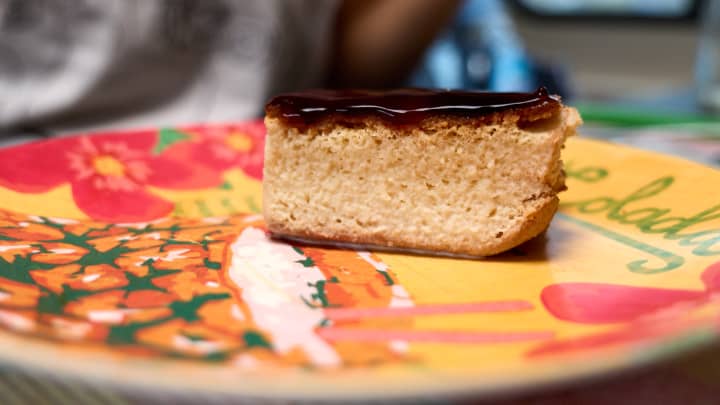
Flija: a baked product made of layers stacked on top of each other, similar to crêpes or pancakes.
Corn bread: a typical, denser-textured bread made with corn flour. We recommend pairing it with cheese!
Pizza: pizza, yes, you read that right! On our culinary tour of this country we wanted to eat a good pizza! It’s not unusual to find pizzerias in Kosovo; in our case we chose carefully, trying the excellent products of “La Napoletana” pizzeria.
Information
Below is some useful information for visiting the country by car or campervan with total peace of mind.
Health insurance
When we travel we insure ourselves with Heymondo, which offers great benefits and a monthly subscription that can be cancelled at any time.
Roads
The roads in Kosovo are in good condition, and we didn’t find any major difficulties getting around the country, even on secondary roads. There are also a few stretches of motorway: we drove the one from Prizren to Pristina and the one from Pristina to the border with Macedonia, and they were in excellent condition.
At the time of writing they’re completely toll-free, but we don’t know for how much longer.
We should mention that the stretch of road between the Montenegro and Kosovo border, known as the no man’s land, is wonderful! A road in excellent condition immersed in nature.
Services and stops
We had no trouble at all either parking during the day or sleeping for free every night. We should mention that there are no free stopover areas equipped for water fill-up and waste disposal, and there are very few drinking water fountains, so plan your needs carefully. There are, however, a few campsites.
Border crossing
Kosovo has signed agreements with Italy that allow entry into the country simply by showing your ID card. If you want to enter the country with your own vehicle, you need to take out vehicle insurance at the border, since the green card isn’t valid in Kosovo.
Costs vary depending on the vehicle, and in our opinion also a bit on the insurer you find on site:
- motorbikes and cars: 15 euros
- trucks up to 1t: 77 euros
- trucks over 1t: 138 euros
When we arrived at the border, the insurer wanted to charge us 138 euros, thinking our vehicle was a truck. After showing that it’s a motorhome/campervan, thanks to the wording on the registration document, we paid 15 euros. We know, however, that other campervan travellers entering from other borders paid 77 euros.
We entered from the only open border crossing between Montenegro and Kosovo and left towards the Macedonian border , and at neither did we have any trouble — quite the opposite. For the first time we found border officers who were friendly and happy to meet us!
Travelling with your pet
To travel outside Europe with your pet you need to have:- passport
- microchip
- valid rabies vaccination
- rabies antibody titration
We recommend bringing a bowl (we use one that clips conveniently onto a backpack) and a water bottle if the day is particularly hot.
Our vlog
If you want to relive our adventures, you’ll find the full playlist here , or press play below:
The title is obviously provocative!
Our maps
If you'd like to thank us, you can offer a 🍪 for our furry friends at the following link:
PayPal - Satispay

Scan the code and thank you! 🐱🙏



Seoul: What to See in 4 Days - Complete Itinerary

A Different Japan: 14 Days on the Road in Wild Kyushu

Andorra by Campervan: A Weekend Discovering Breathtaking Views

Madrid in 1 Day for Free

Trip to Japan 2025: Itineraries and Useful Info

Safe travels across the bridge, little big Olimpia

Vancouver by Campervan: What to See in the City Where Ocean Meets Mountains

Here’s How to Enter Japan with a Vehicle Without a Carnet de Passages

📝 Click to load Disqus comments
Comments will load dynamically