
read also
Sarajevo in One Day: A Tour


Bosnia and Herzegovina is a country still not too overrun by tourism, perhaps due to the legacy of the war that tested the population of former Yugoslavia in the 90s, and which is still paying the consequences today.
Even though Sara had already been to Sarajevo and Mostar, we decided to discover the nation more slowly, on the road, and it was by venturing into its places that we discovered a peaceful land, despite an unstable system of government that causes constant shifts in policy.
We crossed the border overland in the north-east of the country, entering from Croatia. All it took was showing our ID card and the vehicle’s registration document, and within a few minutes we were in a new country, where the tolling of church bells alternates with the muezzin’s call to prayer, and where the Republika Srpska (Serb Republic) coexists with the Federation of Bosnia and Herzegovina, itself divided into 10 cantons.
This political solution, adopted in 1995, has allowed not only different ethnic-cultural groups of Bosnia (Serbs, Croats and Bosniaks) to coexist, but also different faiths (Christian, Muslim, Orthodox and Jewish).
When we travel we insure ourselves with Heymondo, which offers great benefits and a monthly subscription that can be cancelled at any time.
Our itinerary covers the country on a road trip from north to south, since afterwards we continued on to Montenegro.
Banja Luka is the country’s second-largest city and the administrative capital of the Serb Republic. The main street is a constant mix of churches and mosques, small restaurants and bars, in a youthful, convivial atmosphere. We reached the walls of the old medieval fortress, which offers a lovely view over the river dividing the city. Not too far away are the Vrućica thermal springs, genuine hot-water springs set in a small natural canyon. Halfway to our next stop we stopped at the Orthodox monastery of Krupa, whose interior we recommend seeing. Just a few kilometres away you can admire some still-working water mills and, in summer, buy the flour produced on site.
Following the Vrbas river valley you reach Jajce, a destination famous for the waterfalls of the same name, 17 metres high and located right in the town centre. You need to pay a ticket to access them, but by following the locals strolling through the town’s streets and parks, you can admire them from above for free as well. From the town centre, buzzing with bars and small shops, you can climb the hill leading up to the fort (note: they only accept local currency for admission here). 10 minutes’ drive from Jajce are the mills, known as Mlinčići, and Lake Pliva. The mills are no longer in use today, but a handy walkway lets you walk among them and admire the surrounding nature.
This destination wasn’t part of our original itinerary, but needing a place to break up the journey, we tried to make the most of it and visit another “noteworthy” spot. Unfortunately we weren’t particularly impressed by the “pyramids”, and it takes a bit of imagination to call the local hills that. The nature here is certainly pleasantly lush, but it was only really worth stopping as a lunch break before reaching the capital, Sarajevo.
It’s almost impossible to visit Sarajevo without your mind drifting back to the days of the war: the signs of the conflict are everywhere — on the walls, in monuments and gravestones, in museums and exhibitions. Despite this, Sarajevo is a small city but full of life. Here, as in the rest of the country, 4 different religions and cultures blend together, so you find yourself strolling among churches, Orthodox cathedrals, mosques and synagogues.
We dedicated two half-days to the city; if you want to know more you can read the article we wrote about it here.
The first stop was the Tunnel Museum, near the airport. The tunnel was dug in great secrecy by hand, by brave volunteers working in 4 non-stop 8-hour shifts, starting from a private house beneath the airport (the only area not bombed), and it served to help residents escape the besieged city, but also to bring in food and ammunition. It’s located a few kilometres from the city centre and can be visited independently or with a guide (payment only in local currency). There’s a handy paid car park on site where they accept and exchange euros. You can top up on water and stay overnight for a doubled rate. This tunnel, also known as the “tunnel of hope”, was the reason the city managed to stay alive: 700 metres of underground gallery (25 of which can be visited today), used to bring food, water, medicine, diesel and everything needed to keep the population alive into the city. We really recommend visiting it to better understand the tension of those years.
From here we headed to the mountains behind Sarajevo, to reach the old bobsled track used during the 1984 Winter Olympics and later sadly made famous as a position for Serb snipers and mortars during the war. The place can feel a bit grim, being completely abandoned, but the many mortar and bullet marks have been somewhat masked by graffiti and street art. Reaching the top, you get to a truly superb panoramic viewpoint over the city. This area can be reached by car in about twenty minutes, or by the cable car departing from the city centre.
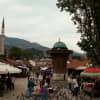
The following day we dedicated to exploring the old district of the city, Baščaršija, a maze of cobbled little streets, dotted with pastry shops, restaurants and craft shops. A big bazaar, in short, dominated by the Gazi Husrev-beg Ottoman mosque. In Sebilj Square there’s an 18th-century fountain, near which you can admire hundreds of pigeons being fed by tourists and locals every day. Not far away are the National Library, almost completely burned down by Serb shelling, and the Latin Bridge, the spot where the assassination of Franz Ferdinand took place, which triggered the First World War. Interesting is “the line dividing east from west” along Baščaršija: a precise point where Islamic architecture suddenly ends and the Austrian part suddenly begins. Here, once again, not just architecture but also religions and cultures blend together. Lastly, we stopped at a small shop to refuel with burek (the typical Balkan filled pastry) and yogurt, and returned to the campervan to head to the town of Konjic.
This town is surrounded by beautiful hills, and if you love summer sports like rowing, it could really be the place for you. We strolled through its little streets and crossed the historic bridge, but if you’re interested and have the chance, you could visit Tito’s Bunker. It’s one of former Yugoslavia’s great secrets, a genuine bunker built to protect the former president and his entourage, now fully restored and turned into a museum: legend has it that Tito himself never even saw it finished. Visits are only possible with a guide at set times; it’s worth checking the website or the information centre beforehand.
Mostar is perhaps the most touristy destination in all of Bosnia and Herzegovina, whose symbol is the Stari Most bridge (old bridge), destroyed in 1993 during the war and rebuilt in 2004. Nowadays it’s not uncommon to see young men diving from the bridge’s 20-metre height in exchange for donations. To get there, just walk along the streets of the small historic centre, buzzing with restaurants and stalls, reach the Koski Mehmed-Pasha mosque (where you can climb the minaret for a panoramic view over the city) and follow the cobblestones along the Neretva river to the bridge. From here you can go down to the left and find yourself on the bank to admire the Stari Most from below, or finish the city tour by heading back through alleys and restaurants to a second little bridge, also quite scenic.
Blagaj is a small village nestled among vineyards and mountains, not too far from Mostar, which owes its importance to the Blagaj Tekija monastery, a dervish monastery dating back to 1500. Recently rebuilt and abandoned by the dervishes during World War II on Nazi orders, it remains unusual to this day for being set into the mountain at the source of the Buna river. Arriving there, you find yourself in a somewhat altered setting, since numerous restaurants have been built along the riverbed, and finding the right path to reach the panoramic viewpoint isn’t the easiest either (by the way, we explain how in our video about it).
Počitelj is an ancient village perched among its walls. It’s impossible not to admire it already from below, but it’s by walking through its cobbled little streets, climbing up to the top of the tower and reaching the fortress, that you really feel catapulted into a distant past. This village was uninhabited for many years, and it’s only thanks to the construction of the new main road that it has gained new life.
Trebinje is the southernmost city, an hour from the border with Montenegro. The city itself doesn’t have much to offer. Worth visiting instead are the Tvrdoš Orthodox monastery, 10 minutes from the city, which contains truly splendid frescoes in a setting surrounded by vineyards, and the Orthodox monastery at the top of the hill, where you can enjoy a breathtaking panorama.
We always stayed overnight for free and used two central paid car parks for daytime visits in the towns of Sarajevo and Mostar. Bosnia and Herzegovina turned out to be a genuinely safe country, and there are plenty of campsites, perhaps a bit pricey for the country, while free water fill-up and waste disposal areas are hard to find.
The roads are in excellent condition, keeping in mind that we only drove on main roads, not motorways.
We hope this itinerary has been helpful and inspiring, and if you have any questions or curiosities, we’ll be waiting for you in the comments! For all the other Balkan itineraries, head to the dedicated section, while if you want to relive our adventures a bit more vividly, you’ll find the videos dedicated to Bosnia and Herzegovina on our YouTube channel.
Find out with the handy map below:









📝 Click to load Disqus comments
Comments will load dynamically