
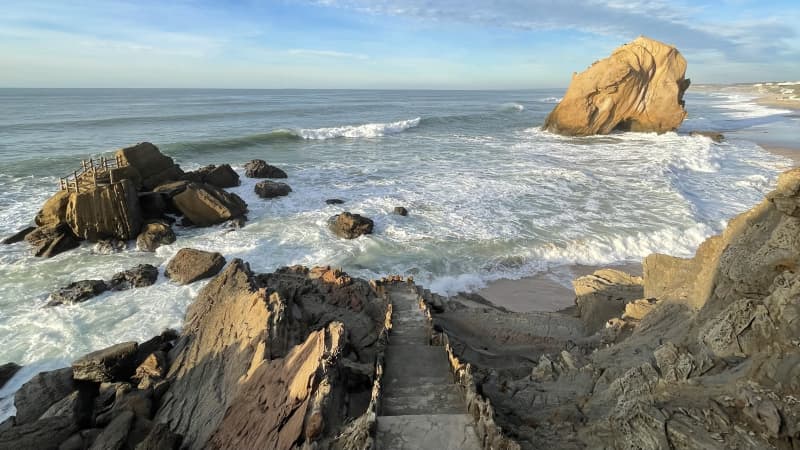
From Aveiro to Lisbon: 10 Days on the Road
Towns with colourful house walls and unforgettable ocean waves even if you don’t surf? Come with us to discover Lisbon and many other small gems of central Portugal, on a 10-day road trip to experience by car or campervan. If instead you’re planning to visit other parts of the country too, head to the general article.
Itinerary
- Day 1 - Aveiro:
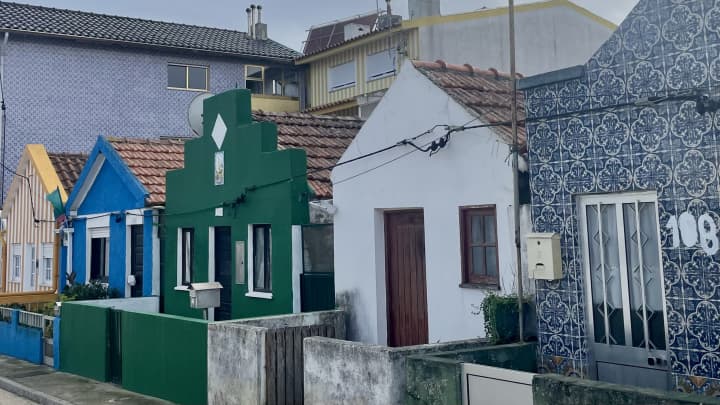
Aveiro sits between the sea and the lagoon and is crossed by canals — hence the nickname Venice of Portugal — once sailed by the brightly coloured moliceiros, traditional tapered boats used to collect seaweed and sargassum. Today the moliceiros are the city’s main tourist attraction, used for touristy river cruises. The town centre has Art Nouveau buildings as well as a very modern university campus. The city of Aveiro doesn’t overlook the ocean, but the two most beautiful beaches near Aveiro are Costa Nova, famous for its characteristic wooden houses with coloured stripes, and Praia da Barra, where you can admire the tallest lighthouse in all of Portugal. They’re just 10 km from the town centre, and in the summer months they can be reached by direct bus.
Day 2 - Coimbra:
Coimbra was the capital of Portugal for over a hundred years and boasts Portugal’s oldest university, as well as one of the oldest in Europe. The city is a maze of narrow, steep cobbled streets, patios, staircases and medieval arches, with elegant buildings overlooking its squares and the Mondego river. There are numerous city parks; we really loved the university park, which is also home to a bamboo forest. Don’t miss peeking into the courtyards — you might spot a student wrapped in the typical black cape of the uniform.
Day 3 - Tomar:
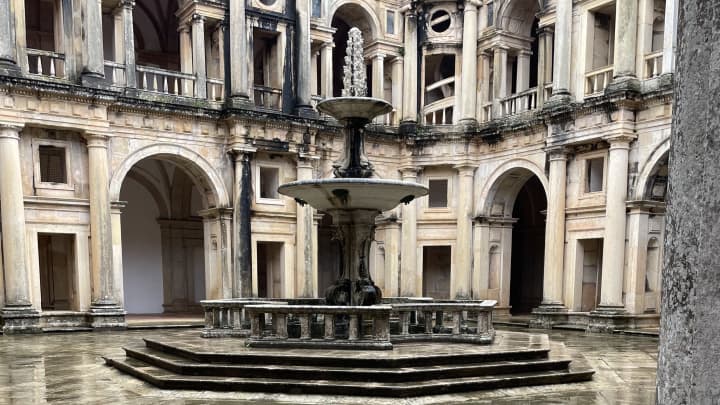
Tomar, once the seat of the Order of the Templars, is home, on a hill above the town, to the Convento de Cristo, one of the most important Renaissance works in Portugal. It’s a genuinely fascinating building, with numerous chapels, cloisters and choirs, and it also houses the Charola, the original Romanesque church built in imitation of the Holy Sepulchre in Jerusalem. The ticket price is €6, including the gardens overlooking the town. We recommend taking a couple of hours to admire the convent .
Day 4 - Nazaré:
Nazaré is considered the most picturesque coastal town, and its crescent-shaped golden sand beach is famous worldwide for its towering waves (the highest ever recorded reached 30 metres!), ridden by surfers from all over the world. Swimming in these waters can be dangerous; better to just watch those skilled enough to handle the waves. At the top of the headland, reachable on foot, you can visit the Fortress of São Miguel Arcanjo and admire the lighthouse that, since the early 1900s, has guided passing ships, with a beam of light visible from 24 km away.
Day 5 - Óbidos:
Óbidos is rightly considered one of Portugal’s most beautiful villages: a maze of cobbled streets and white houses, with balconies adorned with flowers and colourful doors, perched atop a hill dominated by a medieval castle. Don’t miss a walk along the walls, offering breathtaking views over both the town’s rooftops and the surrounding countryside. Strolling through the little streets, we also stumbled upon a really interesting free photography exhibition. Óbidos is also famous for its Chocolate Festival and for ginjinha, the typical cherry liqueur, usually served in little cups made of… chocolate!
Day 6 - Peniche:
Peniche rises on a headland overlooking the sea, and its beaches are overrun by surfers. The harbour is also very lively and busy, and the historic centre preserves a few noteworthy historic buildings. Even if you don’t surf, the nature of these places knows how to catch your eye. 50 km south of Peniche is the seaside town of Silveira, which we discovered by chance, stopping to admire a superb sunset at Praia Formosa.
Day 7 - Ericeira:
Ericeira has been named the world capital of surfing thanks to its coast, a fascinating alternation of cliffs and coves of very fine sand. The town centre, though, is genuinely characteristic too, with narrow little streets, ocean views and a lively atmosphere. Not far from Ericeira, in Mafra, you’ll find the Aldeia Típica José Franco (Aldeia Museu José Franco), an ethnographic museum built in memory of authentic villages and old crafts.
Day 8 - Cabo da Roca:
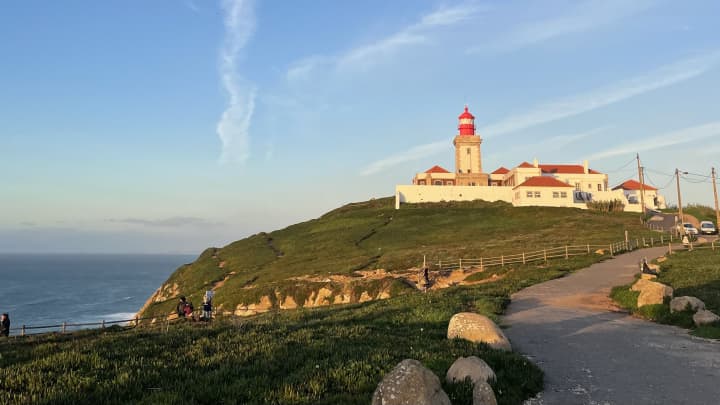
Cabo da Roca is the westernmost point of mainland Europe and one of the most striking Portuguese headlands to visit. Once believed to be the end of the “world”, it’s surrounded by wild nature and offers walks along the cliffs, as well as genuinely spectacular sunsets.
Day 9 - Sintra:
Sintra perhaps has more fame than wonders to show for it. It does have a singular charm, but whether due to high expectations or the poor upkeep of some of its landmarks, it left us a bit disappointed. Visiting each of the attractions is genuinely expensive, on top of the fact that the public transport connecting the various monuments is quite pricey too. For this reason we preferred to only visit the Palácio Nacional de Sintra (€10), a medieval royal palace with numerous interior halls and an impressive collection of azulejos, particularly those covering the walls of the Sala das Sereias, dedicated to mermaids. The Sala dos Brasões is also noteworthy, thanks to its coffered ceiling bearing the coats of arms of Portugal’s 74 noble families. The other palaces you can visit are: the Palácio da Pena, a fairy-tale castle with yellow, pink and purple walls, perched atop a hill offering a breathtaking view over the ocean, and the garden of the same name (we chose to only visit this part, admiring the castle’s exterior); the Quinta da Regaleira, an imposing 19th-century villa; the Convento dos Capuchos (or Cork Convent), lined inside with cork to shelter the monks from the area’s constant humidity; the Parque de Monserrate, home to a botanical museum, exotic gardens with water features, ponds, waterfalls, chapels and picturesque trails. As you can tell, you could spend half a day or 4 whole days seeing this town. If you need more information, you can find it here
Day 10 - Lisbon:
Lisbon is perhaps the city with the least of the typical “saudade” (melancholy) of Portuguese places, since it’s lively and full of things to see. Alfama is the capital’s oldest district, with its house façades with worn plaster, faded azulejos and narrow alleys. Don’t miss the view from Miradouro de Santa Luzia. São Jorge Castle is one of the oldest buildings, sitting on Lisbon’s highest hill. The largest square is Praça do Comércio, near the upscale Baixa district with its fashionable shops, restaurants and traditional pastry shops. The main street is the pedestrian Rua Augusta, running from the Arch all the way to Rossio Square. One of Baixa’s best attractions is the Elevador de Santa Justa, an iron lift that takes you to the top of a tower, offering a 360-degree view over Lisbon and the surrounding hills. Still in this district, we really loved the ruins of the Convento do Carmo. Not far from the centre you’ll find the Belém Tower, a 30-metre-tall bastion surrounded by four small towers, one of Lisbon’s most iconic monuments, and the Jerónimos Monastery. We loved strolling through the city without rushing, admiring it even more at sunset, when the sunlight makes it truly glow.
Fun facts
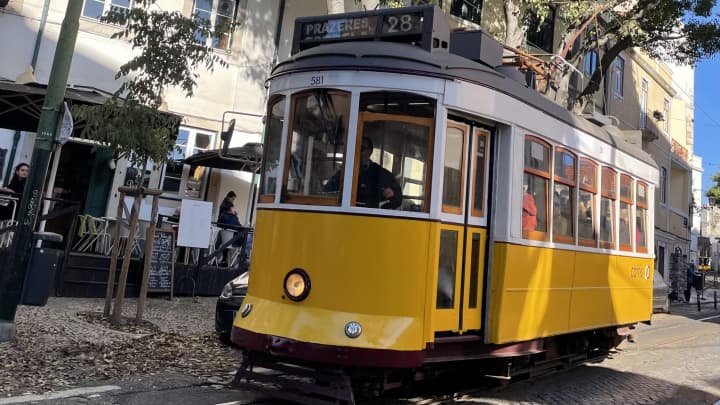
In Lisbon we bought (and devoured!) Pastéis de Belém, at what’s considered the oldest (and, in our opinion, best) pastry shop in the city. It’s the typical custard tart, which we recommend dusting with cinnamon! Don’t worry about missing the typical yellow trams, the city’s symbol! When you least expect it, they’ll zip right past you, and you can snap a photo of them or hop on for a quick ride! If you have some time to spare, you could reach nearby Cascais, a very lovely town with a beautiful coastal walk.

Our vlog
Want to hop aboard the van with us? You can find the full series of our adventures in Portugal at this link .
If you'd like to thank us, you can offer a 🍪 for our furry friends at the following link:
PayPal - Satispay

Scan the code and thank you! 🐱🙏






From Italy to Japan by Van

A Different Japan: 14 Days on the Road in Wild Kyushu

How to Enter Iraqi Kurdistan: Complete Guide for Travellers
Croatia by Campervan: A Decidedly Alternative Itinerary

Safe travels across the bridge, little big Olimpia

Istanbul Low-Cost: Explore the City for Free

Vancouver by Campervan: What to See in the City Where Ocean Meets Mountains

100,000 km by campervan

📝 Click to load Disqus comments
Comments will load dynamically