read also
7-Day Algarve Tour by Campervan


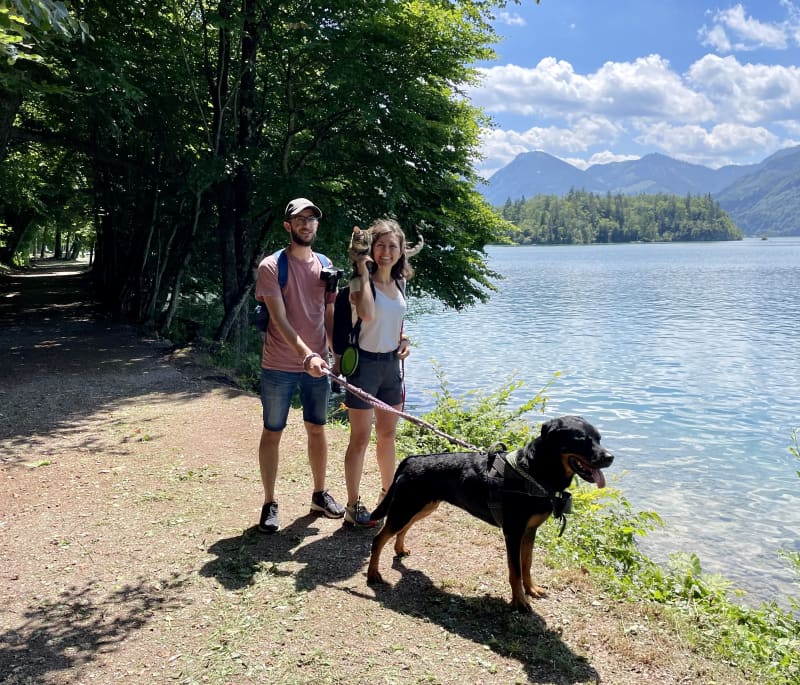
We wandered by van across Austria for three weeks in July 2022, together with our dog and cat, Olimpia and Sakè, in a country that turned out not to be very pet friendly.
We also opted for a detour into Germany, since for years we’d wanted to see Neuschwanstein Castle.
Want to discover our whole itinerary? The stops we list below were reached aboard our small van, but you can do them by motorbike, car or a larger vehicle too.
Table of contents
If you want to read our itinerary in short, you’ll find it here, while if you want to know our thoughts and which stops we consider unmissable, you can click here.
Day 1: our first Austrian stop was Innsbruck (which you can discover here), an elegant, welcoming town. We were able to park for free in the centre since it was a public holiday.
Day 2: as a halfway stop to reach Neuschwanstein, we chose the village of Füssen, whose centre is a maze of medieval-style buildings, topped by a castle. We stayed overnight for free in a quiet residential area.
Day 3: we arrived at one of the car parks of Neuschwanstein Castle early in the morning. If you want to visit the interior, we recommend booking — we didn’t see it since many rooms were closed for restoration. Either way, it’s a striking place, and even the walk to reach the entrance gate is lovely, immersed in the forest (if you don’t want to walk, you can take a horse-drawn carriage). In the early afternoon we moved to a small lake, at Rieden am Forggensee, for a walk along the shore, between crystal-clear waters and structures that look like Native American totems. We stayed overnight for free in a meadow nearby.
Day 4-5: our first stop heading back towards Austria was Murnau am Staffelsee. Before reaching the village we stopped along the shore of a small lake we found by chance (Seehausen am Staffelsee), complete with a scenic wooden swing fixed to a tree. We stayed overnight for free in town, in an area with supermarkets and shops and well-kept gardens nearby. From here we moved near a swimmable lake surrounded by a forest. There’s a pier and a bar very close to the car park, or if you want to venture into nature, just follow the well-marked walking trail. Overnight stays weren’t allowed here, so we moved on to Rosenheim.
Day 6: Rosenheim is the last German city before crossing back into Austria. The city centre is clean and tidy (on Saturday mornings there’s also an interesting market!), and just on the outskirts you can walk through a beautiful park on the riverbank. Unfortunately animals aren’t allowed near the nearby lakes, so we chose to move to the countryside around Teisendorf. We stayed overnight for free.
Day 7: we arrived in Salzburg on a warm Sunday in early June. Since it was a public holiday, we could park for free in the city, letting us leave the animals aboard (in the shade) to visit a couple of sites of interest. The next stop for us was Thalgau, a tiny village nestled among a range of mountains. We stayed overnight for free at a spot near a playground.
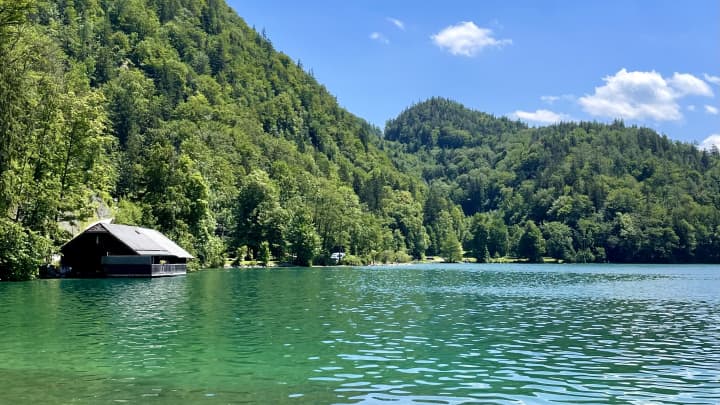
Day 8-9: after a walk around the area among white houses and dirt roads, on the recommendation of an Austrian family we reached the village of Mondsee and the lake of the same name, whose waters mirror the surrounding mountains: a truly beautiful sight! The village’s main street is striking too, as is the church, which also has a small indoor wing with games for children. Free overnight stays aren’t allowed everywhere in Austria, which is why for the night we moved to the hills around Lake Wolfgangsee: here you can walk the whole perimeter, coming across spectacular views and genuinely pleasant shaded spots. Staying on the lake shore is allowed for a fee, daytime only.
Day 10-11: we moved to the shore of Lake Attersee. In this area too, overnight stays aren’t allowed for free, nor can animals swim, and unfortunately they can’t even walk on the grassy shore! For the night we moved to a car park along the road on the nearby hill, overlooking the lake (no big deal, the view from above was genuinely lovely!).
Day 12: we moved on looking for a service area and stopped in front of a lovely village we found by chance, bend after bend: Traunkirchen. The view offered by the waters of the lake it sits on is nothing short of wonderful. Here too, swimming is forbidden for dogs. For the night we moved to Gmunden.
Day 13-14: Gmunden is another village overlooking a lake, with yet another swimming ban for dogs. You can, though, take lovely walks on the pier, have a picnic on the grass together with the locals, visit the castle garden overlooking the pier, and explore the narrow streets of the historic centre. The city is also home to an excellent pizzeria offering takeaway (we enjoyed two excellent pizzas on the lakeshore!). We stayed overnight for free at a car park near the lake.
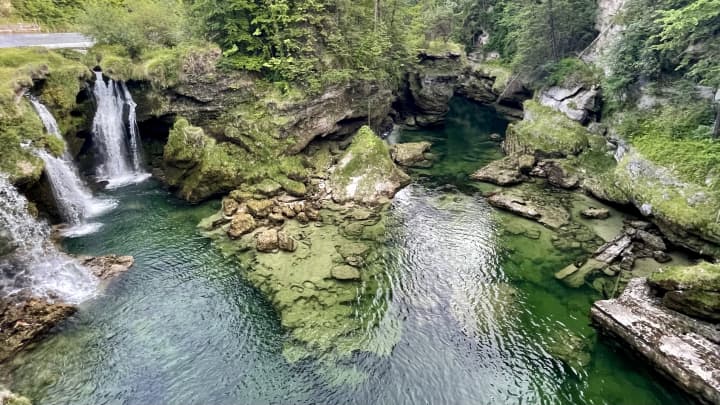
Day 15: we visited the beautiful Traun waterfalls, reachable via a wooden walkway, went for a swim in a nearby river, and slept in the forest, sheltered from the downpour.
Day 16-17: we moved to the lovely town of Linz, parking on an avenue in a residential area from which the city centre, with its little streets and colourful building façades, is easily reached on foot. Given the bad weather on the second day, we took the chance to visit a museum, ARS ELECTRONICA, which turned out to be a genuinely interesting discovery (pets not allowed): the interactive way it explains how to use artificial intelligence in various fields, from music to the creation of new materials, is truly engaging, for adults and kids alike. If you need more information, you’ll find it here .
Day 18: we decided without hesitation to visit the nearby Mauthausen concentration camp. Daytime parking is available in the car park, overnight parking along the Danube at a few spots near the village.
Day 19: another place we discovered by chance, immersed in nature, was the Göbelwarte observation tower, an iron staircase rising upwards, offering a 360-degree view over the hills around the village of Grein. We actually got there by mistake, since we were looking for a quiet spot for a walk and to stop for the night. The visit turned out to be a magical moment: around us the green of the hills, the gold of the wheat fields, a few spots of red from the house roofs, and rising up, first pink, then a soft white, then the blue of the sky and a few clouds drifting quickly with the wind.
Day 20: we moved to Melk, where we took turns visiting the interior of the Abbey, adorned with wonderful gold ornaments, then stayed overnight at the edge of a small medieval village, Mauerbach.
Day 21-22: we dedicated two days to visiting Vienna, admiring its buildings and gardens and of course trying a slice of Sachertorte. For all the details and tips on where to park and how to behave if you’re travelling with a pet (keep in mind the city really isn’t very pet friendly!), head to our full article.
Day 23: leaving the Austrian capital, we decided to move to a nearby countryside village: Rust. Unfortunately the summer temperatures didn’t help, and with 39 degrees under the sun, we visited the village centre and the stork reserve in a bit of a rush.
From this part of Austria our adventures continued east, into Slovakia first and then Poland right after.
Below are just the stops of our adventure. We always stayed overnight for free or at free stopover areas.
Day 1: Innsbruck
Day 2: Füssen
Day 3: Neuschwanstein Castle
Day 4-5: Murnau am Staffelsee
Day 6: Rosenheim
Day 7: Salzburg
Day 8-9: Mondsee and Lake Wolfgangsee
Day 10-11: Lake Attersee
Day 12: Traunkirchen
Day 13-14: Gmunden
Day 15: Traun
Day 16-17: Linz
Day 18: Mauthausen
Day 19: Grein
Day 20: Melk
Day 21-22: Vienna
Day 23: Rust
Throughout Austria the roads are in impeccable condition. The motorway requires a paid vignette (with various duration options and related costs), though we preferred to drive on main roads.
Free overnight stays aren’t tolerated anywhere on Austrian soil. As for facilities, on a few occasions we found campsites refusing to let us use them without staying overnight (even though we were willing to pay to use them). Free areas are available regardless.
As we’ve mentioned several times, Austria isn’t an entirely pet-friendly country. In many cases animals aren’t allowed even in the areas around swimmable lakes, and the same goes for city parks in the capital, as well as museums. If you’re considering a trip to the country with your four-legged friend, keep these restrictions in mind to avoid unpleasant surprises.
In terms of nature and landscapes, Austria stole our hearts. We did, however, find a population that wasn’t too friendly, and restrictions not only related to van life but also towards animals, which made our trip not 100% enjoyable. We would come back, and we will come back regardless, because it’s a clean, tidy and safe country.






📝 Click to load Disqus comments
Comments will load dynamically